The deadline has been sitting in your calendar for three weeks. You know what to do. You're not doing it. Here's what's actually going on — and one thing to try on your next commute.
The Paradox
You know exactly what you should be doing right now.
You have known for some time. The deadline has been visible since it appeared in your calendar three weeks ago, sitting there with the patient confidence of something that knows it will eventually win.
And yet here you are, reading this instead.
The strange thing about procrastination is not that it exists. It is that it persists even when we can see it happening. We are not confused about what we should be doing. We are not unaware of the consequences. We simply don't do the thing — and then feel bad about not doing it — and then still don't do it.
Why?
The Immediate Reward Problem
The first clue comes from a surprisingly simple observation: we are not one person. We are at least two.
The self that sets the alarm for 6 a.m. is not the same self that hears it go off and reaches for the snooze button. The self that commits to writing the report on Friday afternoon is not the same self who arrives at Friday afternoon and decides to reorganise their desk instead.
Behavioural economists call this present bias. The future self is treated like a slightly unreliable acquaintance — someone who will surely handle things, even though the present self has extensive evidence that they won't.
The problem is not laziness. The problem is that our brains weigh immediate rewards far more heavily than future ones. Checking your phone produces a small, reliable hit of satisfaction right now. Writing the report produces a large but distant reward sometime next week. The phone wins, every time, not because you are weak but because your brain is doing exactly what it evolved to do: prefer the bird in the hand.
Discomfort Avoidance
But there is something else going on beneath the surface.
Procrastination is not simply about choosing pleasure over work. It is often about avoiding a feeling.
Think about the task you are avoiding right now. What does it feel like when you consider starting it? There is a faint tightening, a vague sense of resistance, a small voice saying "not yet" or "not today."
That feeling is discomfort. And discomfort comes in many forms:
- The task is boring, and boredom is genuinely unpleasant.
- The task is difficult, and difficulty threatens our sense of competence.
- The task is ambiguous, and ambiguity creates anxiety.
- The task matters, and mattering creates the fear of getting it wrong.
We don't procrastinate because we don't care. We procrastinate because we care too much — or because the task activates a feeling we would rather not sit with.
The psychologist Tim Pychyl spent years studying this. His conclusion was striking: procrastination is not a time-management problem. It is an emotion-regulation problem. We avoid the task to avoid the feeling the task produces. The relief is immediate. The cost is delayed. The maths is the same as present bias, but the currency is emotional.
Uncertainty
There is a particular kind of task that is especially likely to trigger procrastination: the one where you don't know where to start.
You have been asked to write a strategy document. You have been told to "sort out the website." You need to prepare a presentation for people whose expectations you can only guess at.
The task is not necessarily difficult. It is unclear. And unclear tasks create a specific kind of paralysis: the inability to begin because you cannot see the first step.
This is why the oldest piece of writing advice remains the best: start with the worst possible first sentence. Write something deliberately bad. Lower the bar until the task becomes possible. The sentence can be fixed. The blank page cannot.
The same principle applies to any unclear task. Don't try to do it well. Don't even try to do it properly. Try to do it badly, quickly, and then improve it. Perfectionism feeds on the gap between the ideal and the possible. Close the gap by starting with something embarrassingly rough.
Perfectionism
Speaking of which.
Perfectionism is not what most people think it is. It is not the desire to do things well. It is the belief that anything less than perfect is unacceptable — and since perfect is impossible, the logical response is to delay starting until conditions are ideal.
Conditions are never ideal.
The perfectionist procrastinator does not lack standards. They have too many. The report cannot be started until the research is complete. The research cannot be complete until the right sources are found. The right sources cannot be found until the right question is asked. The right question cannot be asked until the thinking is done. The thinking cannot be done until the desk is tidy.
The desk is never tidy enough.
Perfectionism and procrastination are not opposites. They are partners. The perfectionist delays because the moment is never right. The procrastinator delays because the task is never comfortable enough. Both are avoiding the same thing: the messiness of actually beginning.
Identity
There is a deeper layer still.
Sometimes we procrastinate because the task conflicts with who we believe we are.
"I'm not really a spreadsheets person." "I'm not the sort of person who enjoys networking." "I'm creative, not administrative."
These identity statements feel like self-knowledge. Often they are self-limiting beliefs dressed up as personality traits. The task is avoided not because it is unpleasant but because doing it would require being someone we don't want to be — or someone we're afraid we can't be.
The researcher Carol Dweck found that people with a "fixed mindset" — those who believe their abilities are set in stone — are more likely to avoid challenges that might reveal inadequacy. People with a "growth mindset" — those who believe abilities can be developed — are more willing to begin, fail, and try again.
The shift is small but powerful. Instead of "I'm not good at this," try "I'm not good at this yet." The word "yet" changes the task from a verdict on your character into a step in your development.
Environment
And then there is the simplest explanation of all: your environment is working against you.
The phone is on the desk. The email tab is open. The colleague who always wants a chat is three steps away. The browser has seventeen tabs, one of which is a news website that updates every four minutes.
You are not weak-willed. You are surrounded.
The psychologist Kurt Lewin had a useful formula: behaviour is a function of the person and the environment. We spend enormous energy trying to change the person — through willpower, discipline, productivity apps and motivational quotes. We spend almost no energy changing the environment.
Yet the environment is easier to change. Put the phone in a drawer. Close the email tab. Work from a different location. Use a full-screen writing mode. Put on noise-cancelling headphones. Each of these is a small environmental change that removes a source of temptation without requiring any willpower at all.
The most productive people are not the most disciplined. They are the people who have arranged their environment so that discipline is rarely needed.
What This Means for You
Procrastination is not a character flaw. It is a predictable consequence of how your brain weighs rewards, manages emotions, responds to uncertainty, protects your identity and interacts with your environment.
Understanding this changes the question. Instead of "Why am I so lazy?" — which is neither accurate nor useful — try asking:
- What feeling am I avoiding?
- What is the smallest possible first step?
- What would make this task easier to begin?
- What in my environment is making this harder than it needs to be?
These are practical questions. They have practical answers. And they are far more useful than another round of self-reproach.
One Thing to Try on Your Next Commute
Pick one task you have been avoiding. Not the biggest one. Not the most important one. The one that has been sitting there longest, producing the most guilt for the least progress.
On your next commute, do not try to finish it. Do not even try to make real progress on it.
Do five minutes.
Five minutes of the worst, most embarrassing first draft. Five minutes of the ugliest possible beginning. Five minutes of deliberately low-quality, unapologetically rough work.
Then stop. Close the laptop. Look out of the window.
The task is no longer a blank page. It is a bad first draft — and a bad first draft is infinitely easier to improve than a perfect intention.
The task you are avoiding is not as hard as starting it. Once you start, the difficulty shrinks to something manageable. The hardest part is always the gap between knowing and beginning.
📚 Today's Briefing Shelf
- The psychology classicThinking, Fast and Slow — Daniel KahnemanThe Nobel laureate's exploration of the two systems that drive our thinking — and why our intuitive responses so often override our better judgement. The chapter on present bias alone is worth the price of admission.
- On habit and changeAtomic Habits — James ClearA practical, evidence-based guide to building habits by changing your environment and your systems rather than relying on willpower. Particularly useful for the environmental approach to procrastination.
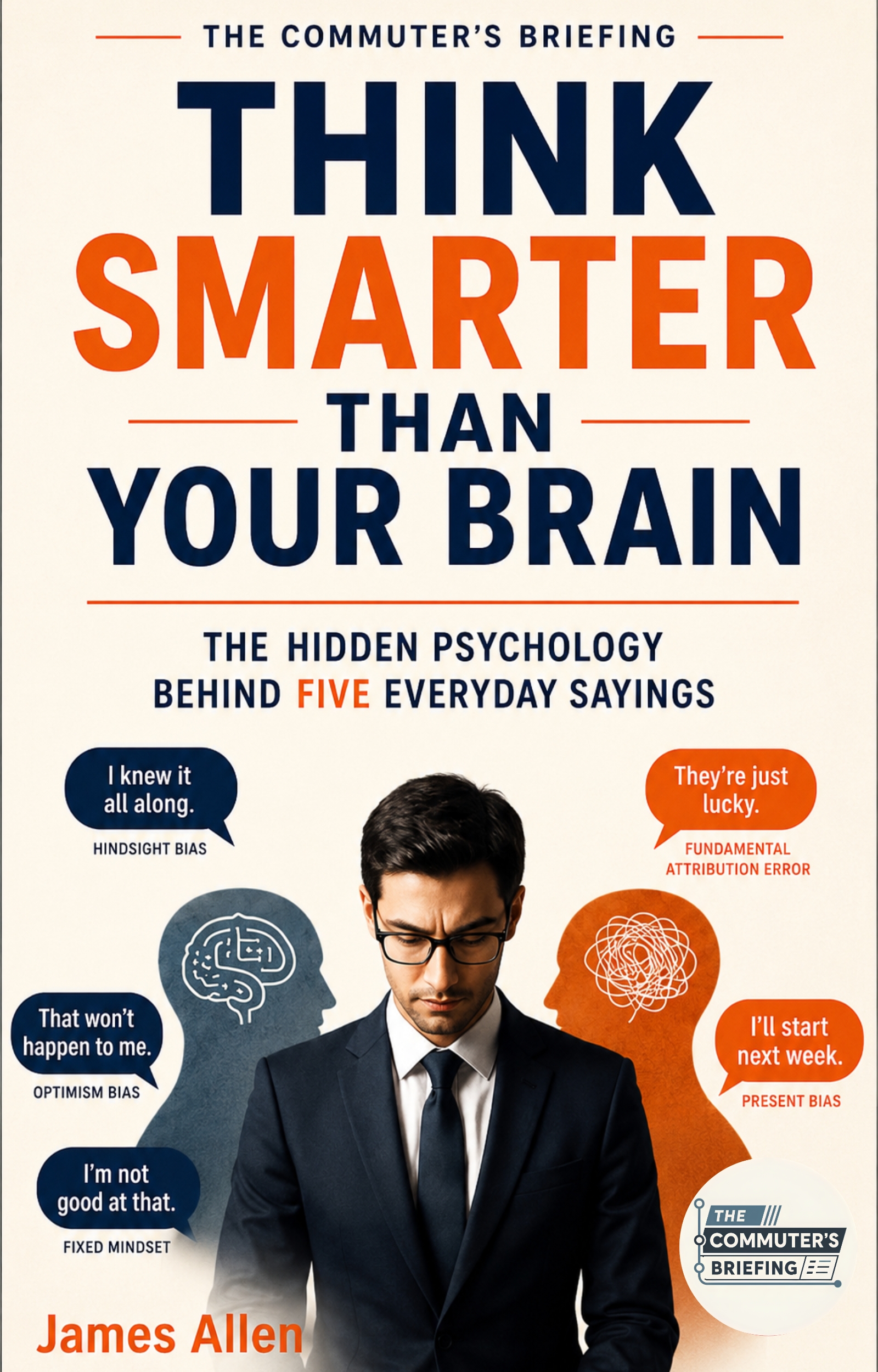
- From the BriefingThink Smarter Than Your Brain — James AllenFive everyday sayings — including 'give them the benefit of the doubt' and 'meet someone halfway' — unpacked through the lens of behavioural science. A short, readable introduction to the biases that shape our decisions.
💬 Conversation Starter
What is the task you have been avoiding longest — and what feeling does the thought of starting it produce?
James Allen · Why Do We Procrastinate Even When We Know What We Should Do?
You are not lazy.
You are not broken.
You are a human being whose brain prefers immediate comfort to distant reward, and whose environment is full of things designed to exploit that preference.
The good news is that understanding the mechanism is most of the solution.
The rest is just starting.