Not the usual business book list. Ten categories that actually matter when you're starting out — from understanding people to staying curious — with books worth carrying into the first year and beyond.
Why This List Is Different
Most "books for your career" lists are really lists of business books. They assume the reader wants to climb a ladder, manage a team, negotiate a raise or understand a spreadsheet.
Those things matter. But they are not what someone starting a new career actually needs.
What they need — what I wish someone had given me — is a set of books that cover the real challenges of the first few years: understanding people you don't yet know, thinking clearly under pressure, communicating when you're not sure what to say, managing yourself when nobody else will, and staying curious when the work gets routine.
Here are ten categories, with one book for each. Some are well-known. Two are mine. None are business books in the conventional sense — and that is the point.
1. Understanding People: The Righteous Mind by Jonathan Haidt
The first surprise of working life is how different other people are. Not just in background or opinion, but in how they see the world.
Haidt, a moral psychologist, explores why good people disagree so fundamentally. His central image is the elephant and the rider: our intuitive responses (the elephant) move first, and our reasoning (the rider) spends most of its time justifying the direction the elephant already chose.
This is not a reason to despair. It is a reason to be more generous. When a colleague sees something completely differently, they are not being difficult. Their elephant is on a different path. Understanding this makes you a better colleague, a better negotiator and a considerably less frustrated human being.
2. Thinking Clearly: Think Smarter Than Your Brain by James Allen
I am including one of my own, and I will be honest about why.
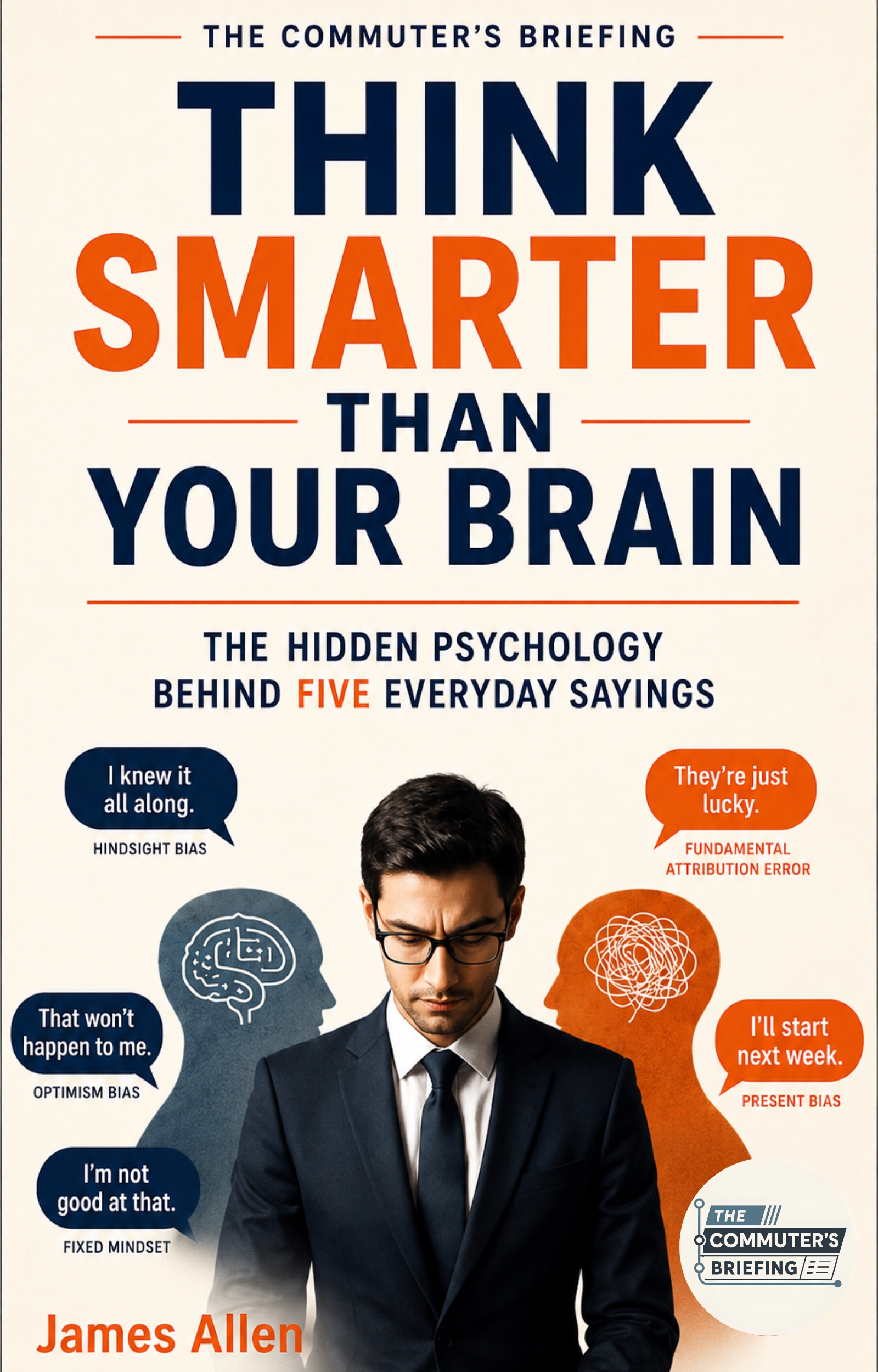
Most books on cognitive bias are excellent and 400 pages long. This one is short. It takes five everyday sayings — "give them the benefit of the doubt," "birds of a feather," "meet someone halfway," and two more — and shows the psychology hiding beneath each.
The result is a quick introduction to the mental shortcuts that shape how we judge people, negotiate and decide. It is designed for a commute, not a sabbatical. And it is the book I wish I had read at 22, when I was making decisions I didn't yet know were biased.
3. Communication: Crucial Conversations by Kerry Patterson et al.
The hardest conversations at work are not the ones about facts. They are the ones about feelings, relationships and identity — the conversation where you need to disagree with your boss, give difficult feedback, or raise a concern everyone is avoiding.
This book is a practical toolkit for those moments. It is not elegant. It is occasionally corporate. But its core insight is valuable: when the stakes are high and emotions are involved, most of us default to silence or violence — saying nothing, or saying too much. The book offers a third way.
4. Uncertainty: Thinking in Bets by Annie Duke
Most career advice assumes you can plan your path. Most careers demonstrate that you can't.
Duke, a former professional poker player, frames life as a series of bets made under uncertainty. The key insight: a good decision can produce a bad outcome, and a bad decision can produce a good one. Judging decisions by their outcomes alone — what Duke calls "resulting" — leads to learning the wrong lessons.
This is essential for anyone starting out, because your early career will be full of decisions made with incomplete information. Learning to separate decision quality from outcome quality is one of the most useful habits you can build.
5. Self-Management: Atomic Habits by James Clear
Nobody will manage your time for you. Nobody will tell you when to stop working, when to rest, or when to push through. These are skills you have to develop yourself.
Clear's book is the best practical guide to building habits I have read. Its core idea is simple: don't focus on goals. Focus on systems. A goal says "I want to write more." A system says "I will write for twenty minutes every morning before checking my phone." The system works because it doesn't require motivation. It requires only that you show up.
Starting a career is largely about showing up — consistently, reliably, even when you don't feel like it. This book explains how.
6. Organisations: The Effective Executive by Peter Drucker
It was written in 1966. It is still the best book ever written about how organisations actually work.
Drucker's central observation is that effectiveness is not a personality trait. It is a habit — and habits can be learned. His advice on time management ("know where your time goes"), on contribution ("ask what you can contribute, not what you are entitled to") and on decisions ("a decision is not made until it has been assigned to someone") remains startlingly relevant.
Read it for the chapter on meetings alone. Drucker wrote: "One either meets or one works. One cannot do both." Sixty years later, nothing has changed.
7. Creativity: The Creative Act by Rick Rubin
You don't need to be an artist to need creativity. Starting a career means solving problems nobody has given you a formula for — and that requires creative thinking.
Rick Rubin, one of the most influential music producers of the last forty years, wrote this book as a meditation on what it means to create anything. It is not about music. It is about attention, openness, and the willingness to begin without knowing where you are going.
It is also beautifully written, which is a bonus.
8. Leadership: Leaders Eat Last by Simon Sinek
You may not be a leader yet. But you will observe leaders from the moment you start work — and understanding what makes a good one (and a bad one) is one of the most valuable things you can learn early.
Sinek's argument is that the best leaders create a "circle of safety" — an environment in which people feel protected enough to do their best work. The worst leaders do the opposite: they create environments of fear, competition and self-protection.
You will encounter both. Knowing the difference, early, will save you years of confusion.
9. Resilience: How to Remain Calm and Useful by James Allen
I am including a second one of my own, because it is the most directly relevant to the question of resilience.
The book gathers fifty voices across cultures and centuries — from Ptahhotep and Confucius to Seneca, Rumi, Julian of Norwich and Mary Wollstonecraft. They disagree about almost everything. Their shared usefulness lies in answering a single question: when circumstances remove control over the journey, what kind of person will make it?
Starting a career involves a great deal of being out of control. Trains are delayed. Decisions are reversed. Plans are disrupted. This book is a pocket-sized reminder that the question is never "will things go wrong?" but "who will you be when they do?"
10. Curiosity: A Short History of Nearly Everything by Bill Bryson
The final category is the most important, and the hardest to find a book for.
Curiosity is the engine of a career. The people who keep growing are not the ones with the best qualifications. They are the ones who keep asking questions — about their work, their field, their colleagues and the world around them.
Bryson's book is a love letter to curiosity. It covers science, history, geology, biology and the sheer improbability of existence — all in a tone that makes you feel that being curious is the most natural and enjoyable thing in the world.
If you start your career curious, and you stay curious, the rest largely takes care of itself.
What This Means for You
You don't need to read all ten. You don't need to read them in order. You don't need to read them before you start.
You need to start. And then, when you hit a wall — and you will — you need to have something on the shelf that helps you understand why.
The right book at the right time is not a luxury. It is a tool. And the best time to acquire tools is before you need them.
📚 Today's Briefing Shelf
- On understanding peopleThe Righteous Mind — Jonathan HaidtWhy good people disagree — and how to be more generous with those who see the world differently.
- On thinking clearlyThink Smarter Than Your Brain — James AllenFive everyday sayings, five hidden biases. A short, readable introduction to the psychology behind how we judge, negotiate and decide.
- On communicationCrucial Conversations — Kerry Patterson et al.A practical toolkit for the hardest conversations at work — the ones about feelings, relationships and identity, not just facts.
- On uncertaintyThinking in Bets — Annie DukeHow to make better decisions when you don't know what will happen — which is most of the time.
- On self-managementAtomic Habits — James ClearThe best practical guide to building habits by designing systems rather than relying on willpower.
- On resilienceHow to Remain Calm and Useful — James AllenFifty voices across cultures and centuries on staying calm and useful when the journey is beyond your control.
💬 Conversation Starter
If you could give one book to your 22-year-old self, what would it be — and what would you hope they learned from it?
James Allen · The 10 Books I'd Give Someone Starting a New Career
The best career advice is not a strategy.
It is a shelf.
Build it slowly. Add to it often. Return to it when the work gets difficult.
The books will still be there when you need them.