
The return-to-office battle is being fought over days, desks and attendance. But the more interesting question is what happens between human beings when they are actually in the same room.
There is a peculiar feature of the great return-to-office argument.
Everyone has become extremely interested in how many days.
Two days. Three days. Four days. Five days if somebody in senior management has recently read an article about "culture".
The number has acquired almost mystical importance.
Three days in the office apparently means collaboration.
Two days means flexibility.
Five days means either commitment or 2019, depending on your point of view.
And yet there is another question that receives considerably less attention:
What exactly are we supposed to do when we get there?
This matters.
Because asking somebody to spend an hour travelling into a city, buy a coffee for £4.20, locate a functioning desk, open a laptop and then spend the next seven hours answering emails and speaking to colleagues through Microsoft Teams is not really a return to the office.
It is working from home with a worse fridge.
The office has to offer something that the spare bedroom cannot.
And fortunately, it does.
It contains other human beings.
That may turn out to be the whole point.
The office has to earn the commute
In August, Airbus became the latest large employer to discover that return-to-office policies are not simply administrative decisions. Reuters reported that the aerospace company had softened plans for increased office attendance after worker resistance and industrial action. The original push had been associated with hopes of improving collaboration, skill-sharing and decision-making.
The disagreement at Airbus is only one example of a much wider argument happening across offices — the quiet, persistent question of why companies want workers back in the office, and what they expect to happen when they get there.
Employers talk about collaboration, innovation and culture.
Employees talk about flexibility, childcare, concentration, cost and the astonishing experience of spending £35 on a train ticket in order to attend a Zoom meeting.
Both sides have a point.
Curious how that journey compares across the Atlantic? Explore The Atlantic Commute →
Working from home solved several genuine problems.
It removed journeys.
It created blocks of uninterrupted concentration.
It allowed people to organise work around life rather than pretending life only happened after 5.30pm.
It demonstrated, rather decisively, that being visibly present at a desk and being productive were never quite the same thing.
We should not unlearn any of that.
But remote work also conducted an enormous accidental experiment.
It asked:
What disappears when colleagues stop being physically near one another?
The answer is more interesting than "meetings".
The conversation that was never in your calendar
Think about the genuinely useful things that happened in offices before anyone called them "collaboration".
Someone leaned across a desk and said:
"Have you seen this before?"
Someone overheard a conversation and realised they knew the answer.
A new employee watched an experienced colleague deal with an awkward client.
Two people walked out of a dreadful meeting together and discovered, in the lift, that they had interpreted it in exactly the same way.
Somebody looked at your face and realised you had not understood.
Someone said:
"Come over here. It'll take thirty seconds."
Someone noticed you were unusually quiet.
Someone made you laugh.
Almost none of this appears on an organisational chart.
None of it needs a meeting invitation.
There is no Teams button labelled:
Overhear Something Unexpectedly Useful.
Yet organisations depend on precisely these moments.
Recent research by Peter Cappelli and Y. Jasmine Wu examined the experience of hundreds of employees working across hybrid and remote arrangements. Their research highlighted a shift towards individual tasks and away from informal help-giving and collaborative work as social ties weakened.
There is a useful phrase for what can disappear:
relational capital.
It is the accumulated reserve of:
trust,
familiarity,
small favours,
shared context,
knowledge of who knows what,
and the confidence to ask somebody a slightly stupid question.
It is difficult to put on a dashboard.
That does not make it unimportant.
Teams are built in the margins
This is one reason the debate about office attendance can become so sterile.
We talk as though the purpose of bringing people together is simply to perform the same work in the same postcode.
It isn't.
If a piece of work requires four uninterrupted hours of concentration, home may be the superior place to do it.
No commute.
No ringing telephone three desks away.
No colleague returning from Pret and asking what everyone wants to do about the dishwasher.
There is nothing heroic about concentrating badly in company.
But teams need something individual productivity does not provide.
They need repeated human contact.
Not necessarily more contact.
Better contact.
A team slowly develops a vocabulary, a rhythm and a sense of what can be left unsaid.
People learn who needs detail and who wants the headline.
They learn who goes quiet when worried.
They discover who is brilliant in a crisis and who should ideally not be told there is a crisis until after lunch.
Trust is rarely constructed through a single "team-building exercise".
It accumulates in hundreds of tiny encounters.
This is less a matter of policy than of psychology.
Which is why a workplace can be full of people and still fail completely at being a human space.
Presence theatre
There is an especially depressing version of the modern office.
Everyone comes in because Tuesday is an "anchor day".
Every desk is occupied.
Every pair of headphones is on.
Slack is open.
Teams is open.
Email is open.
Four people sitting twenty feet apart send each other messages.
Lunch is eaten at the desk.
Someone hosts a video call with three colleagues who are in the same building.
At 5.02pm everyone leaves.
Technically, this has achieved 100 per cent attendance.
It has achieved very little presence.
Call it:
Presence theatre.
This is the central mistake employers risk making.
They confuse proximity with interaction.
Putting human beings in the same building creates an opportunity.
It does not guarantee anything useful will happen.
King's Business School researchers made a related point in June 2026. Their work suggested organisations could create the "worst of both worlds" if they simply tightened attendance rules without creating clear, coordinated and purposeful hybrid working arrangements.
This is important to the argument.
Do not imply the research says office work is bad.
Its point is that hybrid work needs to be designed rather than measured merely by attendance.
That feels right.
The question should not simply be:
How many days are you in?
It should be:
What becomes possible because you are here?
What physical space can do
A room changes behaviour.
A table changes behaviour.
A closed door changes behaviour.
So does a sofa, a corridor, a canteen and somewhere people can make tea without having to reserve it on Outlook.
Space is not neutral.
The best workplaces understand this.
There should be places for concentration.
Places for conversation.
Places for accidental encounters.
Places where six people can argue productively.
Places where two people can say something privately.
Places where a new employee can sit near someone who knows what they are doing.
And, ideally, somewhere you can eat a sandwich without looking directly at a spreadsheet.
A workplace designed entirely around rows of desks implicitly says:
the purpose of being here is individual production.
But if individual production is the only purpose, employees quite reasonably ask why they had to travel.
The modern office needs to become less like a computer terminal with rent and more like a piece of social infrastructure.
Somewhere relationships become easier.
The people you don't know you need
There is another reason human proximity matters.
We are rather bad at predicting which conversations will be useful.
If I know exactly who I need, exactly what I need from them and exactly when I need it, digital communication is magnificent.
I can message them.
Schedule them.
Email them.
Call them.
AI can summarise what they subsequently say.
The more interesting organisational problem is the thing I don't know that I don't know.
I don't know that Rachel solved the same problem two years ago.
I don't know that Mohammed knows somebody in Finance who can fix it in an afternoon.
I don't know that the new graduate has spotted the obvious flaw because everyone senior has become too familiar with the project.
I don't know that the person sitting beside me worked in exactly this market at their previous employer.
Until we talk.
Digital tools are exceptionally good at connecting known points.
Human environments are unusually good at creating unexpected collisions between them.
Not every collision is useful, obviously.
Some produce a forty-minute discussion about parking.
But that is the price of living among humans.
And then AI arrived
There is an irony in arguing about offices at exactly the moment artificial intelligence is becoming astonishingly good at producing conventional office output.
AI can:
draft the email,
summarise the document,
produce the agenda,
rewrite the proposal,
analyse the spreadsheet,
suggest the presentation,
and create a perfectly respectable paragraph containing the words "strategic", "stakeholder" and "alignment" without experiencing any embarrassment whatsoever.
This ought to change what we value.
The repetitive production of polished material is becoming cheaper.
The human abilities around that material become more important.
Judgement.
Timing.
Taste.
Context.
Trust.
Knowing when somebody is unconvinced despite saying "fine".
Knowing that the meeting has technically reached a decision but nobody in the room believes it.
Knowing that this is the wrong moment to push.
Knowing that an inexperienced colleague needs encouragement rather than another document.
Knowing that the clever answer is not necessarily the useful answer.
AI can process the notes.
Human beings still have to hear the music.
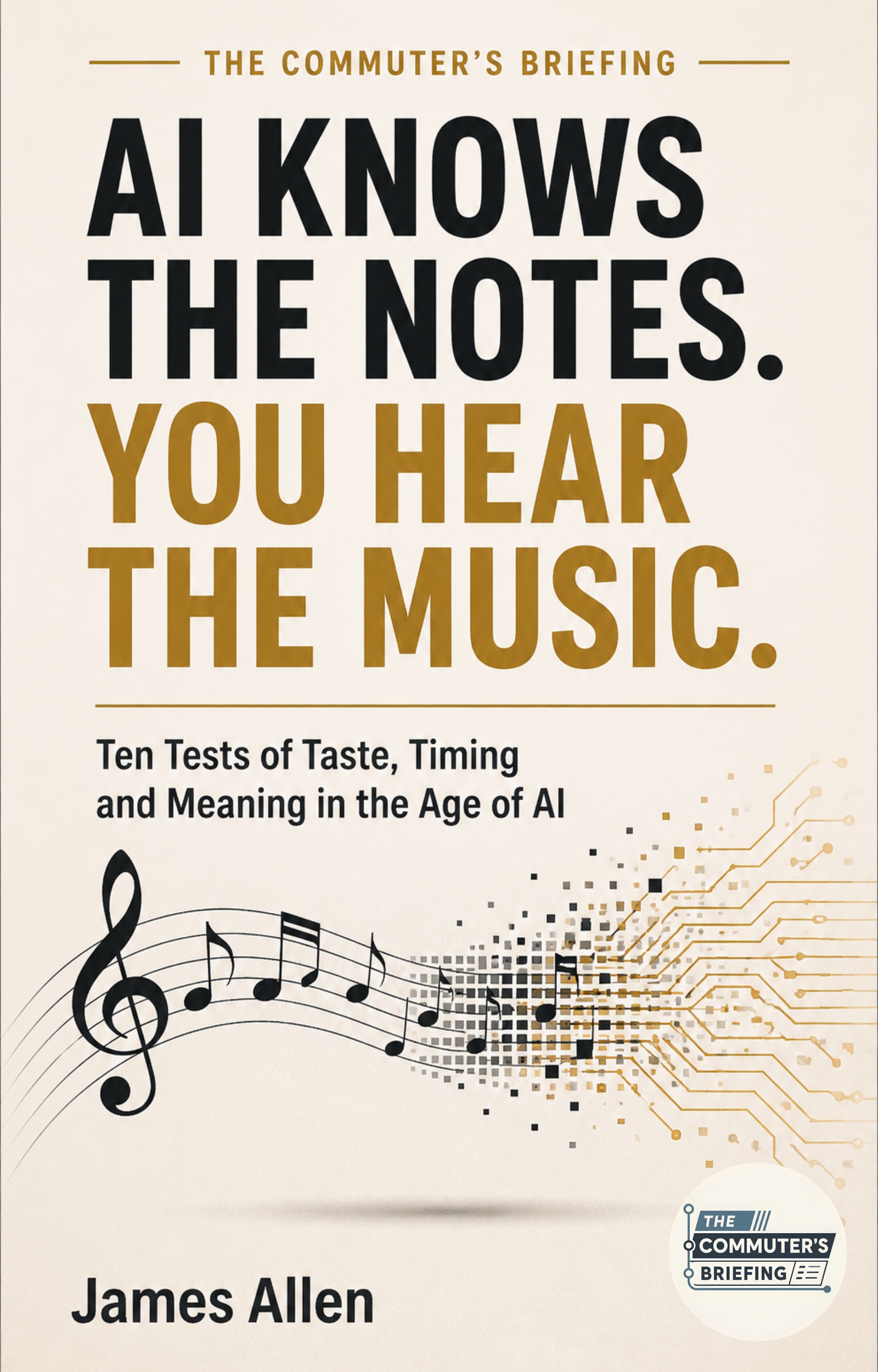
That is the argument at the heart of AI Knows the Notes. You Hear the Music.
And it applies to the future of the office too.
The more machines can produce, the more valuable genuinely human interaction becomes.
Not because humans are magically superior at everything.
We aren't.
The spreadsheet has had us beaten for years.
But organisations are not only information-processing machines.
They are groups of people attempting to trust one another enough to do difficult things together.
From the Imprint


AI Knows the Notes. You Hear the Music.
Ten Tests of Taste, Timing and Meaning in the Age of AI
AI can generate the email, presentation and answer. The increasingly valuable question is whether you can tell which one matters. AI Knows the Notes. You Hear the Music. explores ten distinctly human skills — judgement, taste, timing, interpretation and meaning — that become more valuable as machines become more capable.
Kindle ebook · £4.99
So should everyone go back five days a week?
No.
Or, more accurately:
That is the wrong question.
Some jobs benefit enormously from physical presence.
Some benefit occasionally.
Some barely require it.
Some employees need quiet more than company.
Some need colleagues around them to learn.
A new employee and a twenty-year veteran may require completely different working patterns.
There is no mystical number of office days that transforms an organisation into a community.
King's research makes the useful point that coordination matters.
Tuesday in the office is considerably less useful if everyone you need has chosen Wednesday.
Hybrid work is therefore not simply an individual benefit.
It is a collective design problem.
This is where organisations sometimes become uncomfortable.
"Come in three days" is easy to write.
"Think carefully about when human interaction improves the work and organise teams around those moments" is considerably harder.
The second, unfortunately, is management.
Make office days different
There is a simple test for an organisation demanding more office attendance.
Ask:
What should happen on an office day that would not happen at home?
Good answers might include:
- coaching
- creative disagreement
- mentoring
- complex decisions
- introductions
- learning
- workshops
- relationship-building
- difficult conversations
- team problem-solving
- celebrating something
- welcoming someone new
- sitting beside someone and learning how they actually work
A bad answer is:
"People will be visible."
Visibility is not collaboration.
Neither is occupying expensive furniture.
If Tuesday is office day, organisations should protect Tuesday for the things that justify proximity.
Reduce the video calls.
Move individual admin elsewhere.
Make room for lunch.
Let conversations overrun occasionally.
Put junior people near experienced people.
Create spaces where it is actually possible to talk.
Don't insist everyone comes in and then reward the person who spends the entire day wearing noise-cancelling headphones.
The office has to earn the commute.
The five-second test
Next time somebody announces a new attendance policy, ask one question:
What will we be able to do together that we cannot do as well apart?
If there is a convincing answer, going in may be entirely worthwhile.
If there isn't, three days can feel as arbitrary as two.
The best future is unlikely to involve abolishing offices.
Nor is it likely to involve pretending 2019 can simply be reloaded from a backup.
Something more interesting is possible.
Home for the work that benefits from solitude.
Technology for the work that benefits from speed and distance.
AI for the work machines can do brilliantly.
And shared physical space for those peculiar, inefficient, unpredictable encounters through which human beings teach, trust, notice, challenge, reassure and occasionally make one another laugh.
Your boss may indeed want you back in the office.
The reasonable response is not necessarily:
Why?
It is:
What shall we do when we get there?
If this idea stayed with you…
Four books about why places, gatherings and teams matter.
- On gatheringThe Art of Gathering — Priya ParkerParker's central argument is that bringing people together is not enough: a worthwhile gathering needs purpose. Particularly relevant to employers who believe simply putting everybody in the same building constitutes collaboration.
- On teamsThe Culture Code — Daniel CoyleCoyle examines how successful groups develop cohesion, cooperation and trust. Useful for thinking about the difference between having colleagues and actually becoming a team.
- On spaceJoyful — Ingrid Fetell LeeA designer's exploration of how physical surroundings affect how people feel. A useful reminder that if organisations want people to return to physical spaces, those spaces should perhaps be places human beings actually want to inhabit.
- On social spacePalaces for the People — Eric KlinenbergKlinenberg's idea of “social infrastructure” explores the importance of physical places that allow connections and communities to form. Written principally about civic life, but highly suggestive for anyone thinking seriously about what shared workplaces are for.
Four very different books. One shared idea: putting people in the same place is only the beginning.
💬 Conversation Starter
What should happen on an office day that would not happen at home?
James Allen · Your Boss Wants You Back in the Office. But Do They Know Why?
The office has to earn the commute.
Everything else is just counting days.
A few obvious questions
The ones most people are quietly asking.
Why do companies want employees back in the office?
Employers commonly cite collaboration, knowledge-sharing, culture, mentoring and faster decision-making. These are real benefits of physical proximity. The difficulty is that simply requiring attendance does not automatically produce them. An office full of people wearing headphones, on separate video calls, has achieved presence without much collaboration. The outcome depends on what the time is organised around, not merely that it happens.
Is hybrid working ending?
No. Hybrid working remains widespread, though some organisations are increasing attendance expectations. Policies vary greatly by employer, industry and role, and several high-profile attempts to tighten rules have been softened after employee resistance. The more useful question is not whether hybrid work is ending but how it is being designed.
Is working in the office better for collaboration?
Some forms of collaboration, informal learning and relationship-building can benefit from face-to-face contact. Concentrated individual work, by contrast, may be better done remotely. The evidence does not say office work is inherently better. It suggests that purpose and coordination matter: the same day in the office can be productive or wasteful depending on what it is organised to do.
How many days a week should people work in the office?
There is no universal ideal number. Team dependencies, role, seniority, type of work and coordination across the team all matter more than treating a particular number as inherently correct. Tuesday in the office is considerably less useful if everyone you need has chosen Wednesday. The number is less important than the design behind it.
Sources & further reading›
- Reuters — “Airbus backs down on return-to-office after protests, sources say” (21 August 2026)
- King's College London — “Return-to-office rules risk creating 'worst of both worlds' for hybrid workers” (10 June 2026)
- Peter Cappelli and Y. Jasmine Wu — “How Remote Work Is Reshaping the Office”, California Management Review (2026)