ArticleFree · 6-minute read
Tom Holland Is Having the Best Year of His Life. Why Success Still Makes Us Want to Disappear for a While.
Getting what you wanted can be surprisingly exhausting.
Psychology
No. 24 · 14 September 2026 · Free · 8-minute read

Andy Burnham, the Great North Run, and the quiet business of staying yourself.
There are many ways becoming Prime Minister might change a person.
More security. More officials. More motorcades. More people suddenly finding your jokes considerably funnier than they did six months ago.
In Andy Burnham's case, there has also been one significant concession to high office:
new running shorts.
Yesterday, Burnham joined a record 63,000 people running the 13.1 miles from Newcastle to South Shields in the Great North Run. He became the first serving Prime Minister to take part, finished in 1:57:35, and ran in support of homelessness charity Changing Lives. (BBC News)
But something he said before the race was more interesting than his finishing time.
People had apparently said to him after he became Prime Minister:
Don't change.
Burnham had already entered the Great North Run while he was Mayor of Greater Manchester. He had run it before. So, he explained, becoming Prime Minister wasn't going to stop him doing it again.
In effect: this is something I did before Downing Street, and I am going to keep doing it now.
There is something rather lovely about that.
But there is also something slightly wrong with the phrase don't change.
Because, of course, we should change.
That might be the whole point.
The Big Idea
You are going to be changed by this week.
The question is by what.
Every job changes us a little.
Every relationship does.
So does money. Success. Failure. Parenthood. Responsibility. Illness. Age. Grief. Praise. Criticism. The people we sit beside. The things we read. The videos we watch while supposedly only checking our phones for thirty seconds.
Even a commute can do it.
Human beings are wonderfully porous creatures.
We absorb things.
The dangerous fantasy is that somewhere underneath all these influences sits a perfectly preserved, vacuum-packed Real Me, which simply needs to remain untouched.
There probably isn't.
We are constantly becoming somebody.
So perhaps the better instruction is not:
Don't change.
It is:
Be careful what you allow to change you.
That is a much more useful idea on a Monday morning.
Because there is an enormous difference between growth and drift.
Growth happens when we encounter something worthwhile and permit it to alter us.
A demanding job might make us more capable.
A wise colleague might make us less certain of ourselves.
Having children may rearrange our priorities.
A failure might make us humbler.
A difficult conversation might reveal something about ourselves we needed to know.
A great book can occasionally perform minor surgery on your worldview somewhere between Clapham Junction and Waterloo.
Those changes are not betrayals of who we are.
They may be how we become more fully ourselves.
Drift is different.
Drift happens when we slowly become somebody without ever quite deciding to.
The workplace becomes cynical, so we become cynical.
Everybody is permanently busy, so we decide being busy must mean being important.
The loudest person in the meeting teaches us to become louder.
An algorithm discovers that outrage keeps us looking at our phone, and six months later we are walking around mildly furious with people we have never met.
Nobody chose any of this.
It just accumulated.
That may be the most important thing in Burnham's Great North Run story.
It isn't really that he has remained unchanged.
Becoming Prime Minister should change someone.
The responsibility should change you.
The people you meet should change you.
The things you learn should change you.
But the office should not be allowed to decide everything about the person occupying it.
Whatever your politics, there is something appealing in the image of somebody entering one of the most status-heavy buildings in Britain and then turning up on a Sunday morning to do something he was doing beforehand — along with 63,000 other people, wearing a race number and having to get himself from Newcastle to South Shields under his own steam.
No motorcade can help much at mile eleven.
And perhaps we all need an equivalent.
Something that reminds us:
I was this person before the promotion.
I cared about this before anybody applauded me for it.
These people mattered before I became busy.
This is something I do because it is mine.
Burnham himself has talked about trying to resist the gravitational pull of Westminster and doing politics differently. Before becoming Prime Minister, he spoke about giving people greater control over their own lives and creating a stronger sense of agency.
Agency is a useful word.
It means remembering that although we cannot control everything that happens to us, neither are we merely passengers.
You don't control the whole route.
You may not have chosen the hill.
You certainly didn't order the rain.
But you still have some say over how you run the next mile.
Your Monday experiment
So here is something worth asking on the journey into work today:
What is changing me at the moment?
Not what is changing around you.
What is changing you?
Is your work making you more generous or more impatient?
Are the people around you making you braver or more cautious?
Is your phone making you better informed or merely more agitated?
Is ambition enlarging your life — or quietly consuming it?
Has somebody else's definition of success become yours without you noticing?
And then comes the more interesting question:
What would you like to be changed by instead?
Perhaps you need more time with the colleague who makes you think bigger.
Perhaps you need to read something difficult.
Perhaps you need to telephone the friend who remembers who you were before your current job title existed.
Perhaps there is something you used to do — run, paint, volunteer, make music, coach a team, walk somewhere without headphones — that needs reclaiming.
Not because nostalgia is good.
But because sometimes returning to an old thing reminds us which parts of ourselves are worth carrying forward.
The Great North Run has a fixed destination.
Life, irritatingly, does not.
There will always be people offering directions.
Bosses. Politicians. Parents. Friends. Advertisers. LinkedIn. Instagram. People on podcasts who wake at 4.37am and own inexplicably large water bottles.
Some of them are worth listening to.
Some are not.
Maturity may be less about becoming impervious to influence and more about becoming selective about it.
Let good people change you.
Let difficult experiences deepen you.
Let great ideas disturb you.
Let love rearrange your priorities.
Let evidence change your mind.
But be wary of allowing fear, fashion, resentment or somebody else's expectations to quietly write your personality for you.
Because perhaps being true to yourself was never about remaining exactly the same.
Perhaps it is about retaining the pen.
You cannot stop the world changing you. But you can have some say in what it changes you into.
The Big Idea
You cannot stop the world changing you. But you can have some say in what it changes you into.
☕ Conversation Starter
What is one thing in your life that keeps you recognisably you? And the harder follow-up: what is influencing you at the moment that probably shouldn't be? That ought to improve Monday-morning coffee considerably.
James Allen · No. 24 — What Gets to Change You?
📚 Today's Briefing Shelf
There will be plenty this week you cannot control.
Meetings will move.
Trains will be late.
Somebody will send an email beginning “Just circling back…”
Events will push you around a little.
That is life.
But somewhere between here and next weekend, try to retain one small piece of authorship.
Choose a good influence.
Protect something that matters.
Change your mind when you should.
Refuse to change it merely because everybody else has.
And keep running towards the person you actually want to become.
Have a good Monday.
Another idea for the journey
Getting what you wanted can be surprisingly exhausting.
Explore the topic
More on Psychology→The Monday Briefing
Free · Five minutes · Unsubscribe anytime.
Free · Every Monday · Unsubscribe anytime · Privacy
Getting what you wanted can be surprisingly exhausting.
Psychology
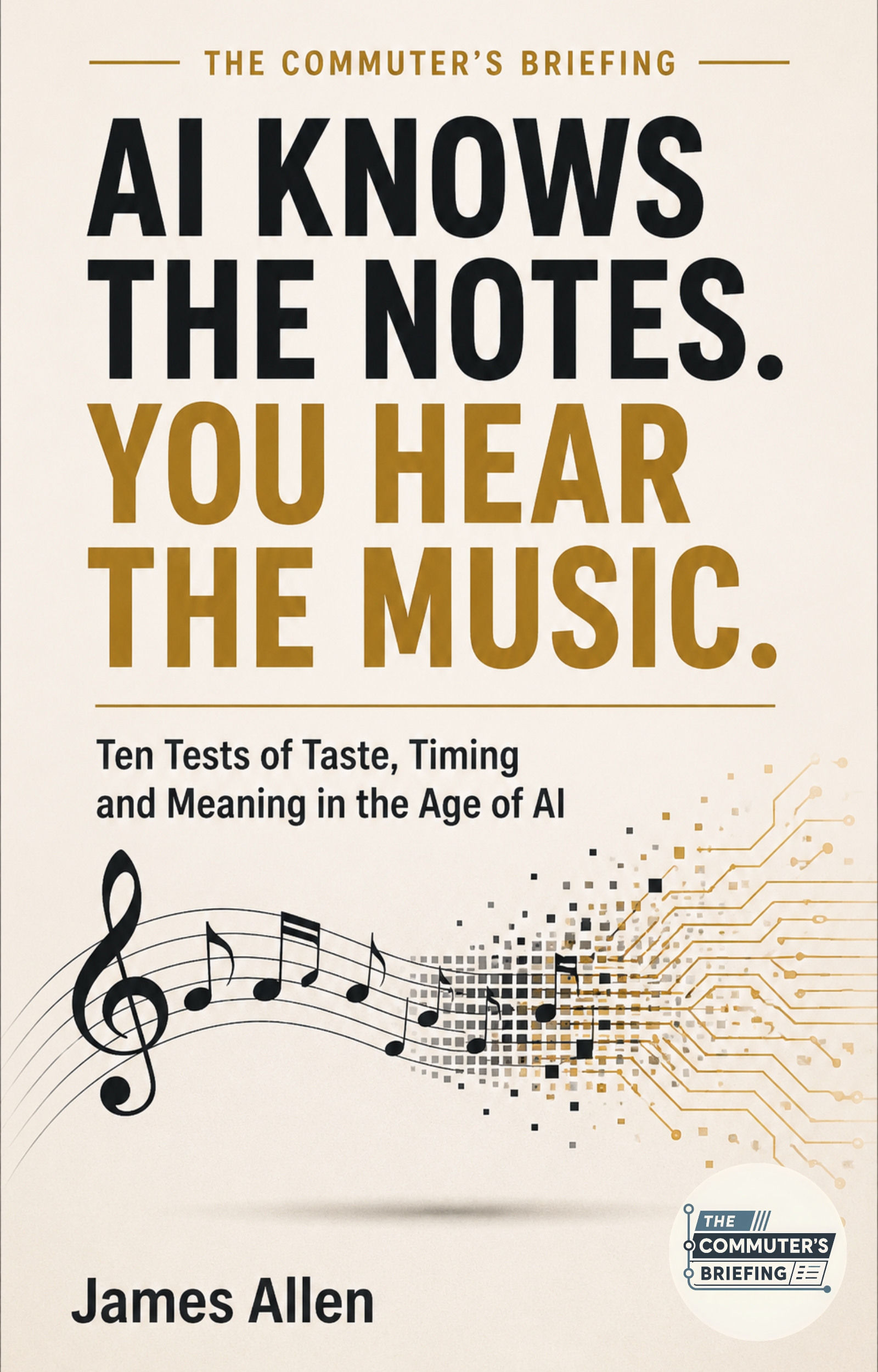
As AI gets better at producing polished, competent work, the scarce skill moves somewhere else — towards judgement. Knowing when something is technically fine and somehow not quite right may become the most valuable thing a person can say.
Behavioural Science
Two major working cities, two very different scales — and a morning journey increasingly shaped by the car.
Behavioural Science
Enjoyed this briefing? Follow @booksbyjamesallen for shorter ideas between Mondays.
Follow @booksbyjamesallen
