As AI gets better at producing polished, competent work, the scarce skill moves somewhere else — towards judgement. Knowing when something is technically fine and somehow not quite right may become the most valuable thing a person can say.
There is a particular moment in modern office life when someone produces something with AI and everybody is briefly impressed.
The presentation looks polished.
The headings are sensible.
There are bullet points.
There is possibly even a diagram involving arrows.
Nobody can quite explain what is wrong with it.
And yet everybody knows.
It is the intellectual equivalent of an airport hotel room: perfectly competent, strangely familiar, and entirely impossible to remember once you have left.
This is becoming one of the more interesting consequences of artificial intelligence.
AI is getting better.
Much better.
Which means the interesting question is no longer whether it can produce something that looks professional.
Of course it can.
The interesting question is whether professional-looking is still enough.
The Big Idea
For most of modern working life, producing competent material required effort.
A decent report took time.
A good presentation required somebody to think about the structure.
Even a reasonably polished email involved at least a few minutes staring at the screen wondering whether "Kind regards" sounded chilly.
Generative AI has changed the economics of competence.
It can produce ten headlines, three versions of an email, a meeting summary and a draft strategy before you have located yesterday's coffee cup.
That is genuinely useful.
But once competent material becomes abundant, competence itself becomes less impressive.
The scarce skill moves somewhere else.
Towards judgement.
Not judgement in the grand sense of possessing exquisite taste in architecture and refusing to drink wine with a screw cap.
Something much more ordinary.
The ability to look at something that is technically fine and say:
No. That isn't quite it.
That sentence may become one of the most valuable things a person can say in an AI-assisted workplace.
AI Is Very Good at the Middle
Imagine asking an AI system for twenty names for a new workplace initiative.
It will probably produce twenty perfectly serviceable answers.
There will be words such as Momentum, Catalyst, Elevate, Transformation and possibly Synergy if the machine is feeling particularly cruel.
None will necessarily be bad.
That is precisely the problem.
AI is extraordinarily good at finding the middle of the road.
And, to be fair, the middle of the road is often where you want to be.
You probably don't need groundbreaking originality when asking it to summarise the minutes of Tuesday's procurement meeting.
You want clear.
Fast.
Accurate.
Boring is entirely acceptable.
But there are other moments when choosing the most statistically plausible answer produces something that is technically excellent and somehow lifeless.
The speech that contains all the right sentiments but sounds as though it could have been delivered by anybody.
The apology that is grammatically impeccable and emotionally useless.
The strategy filled with words everyone recognises but nobody could actually implement.
The presentation whose conclusion appears to have arrived without anybody having an actual opinion.
AI has not necessarily failed in these situations.
Sometimes it has done exactly what was asked.
The human failed to notice that what was asked wasn't good enough.
The Danger of the First Good Answer
This may be AI's most subtle effect on us.
Not that it will stop us thinking.
That would be too obvious.
The greater danger is that it gives us something good enough so quickly that we stop thinking sooner.
Before generative AI, a blank page forced a decision.
What are we trying to say?
Who is this actually for?
What matters here?
Now the blank page can disappear instantly.
Wonderful.
Except the disappearance of the blank page also removes the uncomfortable few minutes in which we sometimes discovered what we actually thought.
The first AI answer often creates momentum.
And momentum has a peculiar psychological power.
Once something exists on the screen, we begin editing it rather than questioning it.
The draft quietly becomes the assumption.
The assumption becomes the structure.
The structure becomes the final version.
Nobody ever asks whether the whole thing should have started somewhere else.
The impressive new skill, therefore, may not be generating.
It may be rejecting.
The Person Who Says No
This sounds negative.
It isn't.
Consider any genuinely good creative or professional work.
Someone had to discard things.
The novelist deleted paragraphs.
The designer rejected layouts.
The chef tasted the sauce and decided it needed something.
The comedian removed the line that was funny but killed the rhythm.
The good manager rewrote the announcement because the technically correct version sounded like something issued during a hostage negotiation.
Judgement has always involved exclusion.
The difference is that AI can now provide the material to exclude at extraordinary speed.
That changes the human role.
We become less like typists and more like editors.
Less concerned with producing every note ourselves and more responsible for deciding what the music is supposed to sound like.
That is not a smaller job.
It is arguably the more important one.
You Still Have to Read the Room
There is another thing worth remembering.
Language does not happen in a laboratory.
It happens between people.
The same sentence can be reassuring from one person and insulting from another.
A joke can be funny at 10.15 and career-ending at 10.16.
"Thanks for your input" can mean sincere gratitude, mild irritation or the beginning of a departmental blood feud.
Humans become reasonably good at navigating this because we spend our lives accumulating context.
We remember the previous meeting.
We know who has fallen out with whom.
We notice the silence after someone's name is mentioned.
We know that Brian from Finance has been having a dreadful week and perhaps today is not the day for the joke about spreadsheets.
AI can help us reason about context.
Increasingly, it can do so impressively.
But we remain responsible for the decision.
That is the distinction worth defending.
Not because humans possess some mystical quality machines can never approach.
But because responsibility cannot sensibly be outsourced with the sentence:
"ChatGPT thought it sounded okay."
Conversation Starter
Try this one today:
Has AI made us better at producing things — or merely quicker at reaching the first acceptable version?
It is a much more interesting question than whether AI is "good" or "bad".
And considerably less likely to turn lunch into a TED Talk nobody requested.
Today's Briefing Shelf
A Classic
The Art of Rhetoric — Aristotle
Long before anybody worried about algorithms, Aristotle was interested in the relationship between the speaker, the argument and the audience.
His enduring point is that effective communication isn't merely about assembling correct statements.
It is about understanding who is listening, what matters to them and what a particular moment requires.
Artificial intelligence has made those questions more relevant, not less.
An Indie
Several Short Sentences About Writing — Verlyn Klinkenborg
A wonderfully unusual little book about paying attention to sentences.
Its deeper lesson is useful well beyond writing: stop assuming that because words arrive fluently they deserve to stay.
When machines can produce enormous quantities of smooth prose, learning to notice individual sentences becomes rather radical.
From the Imprint
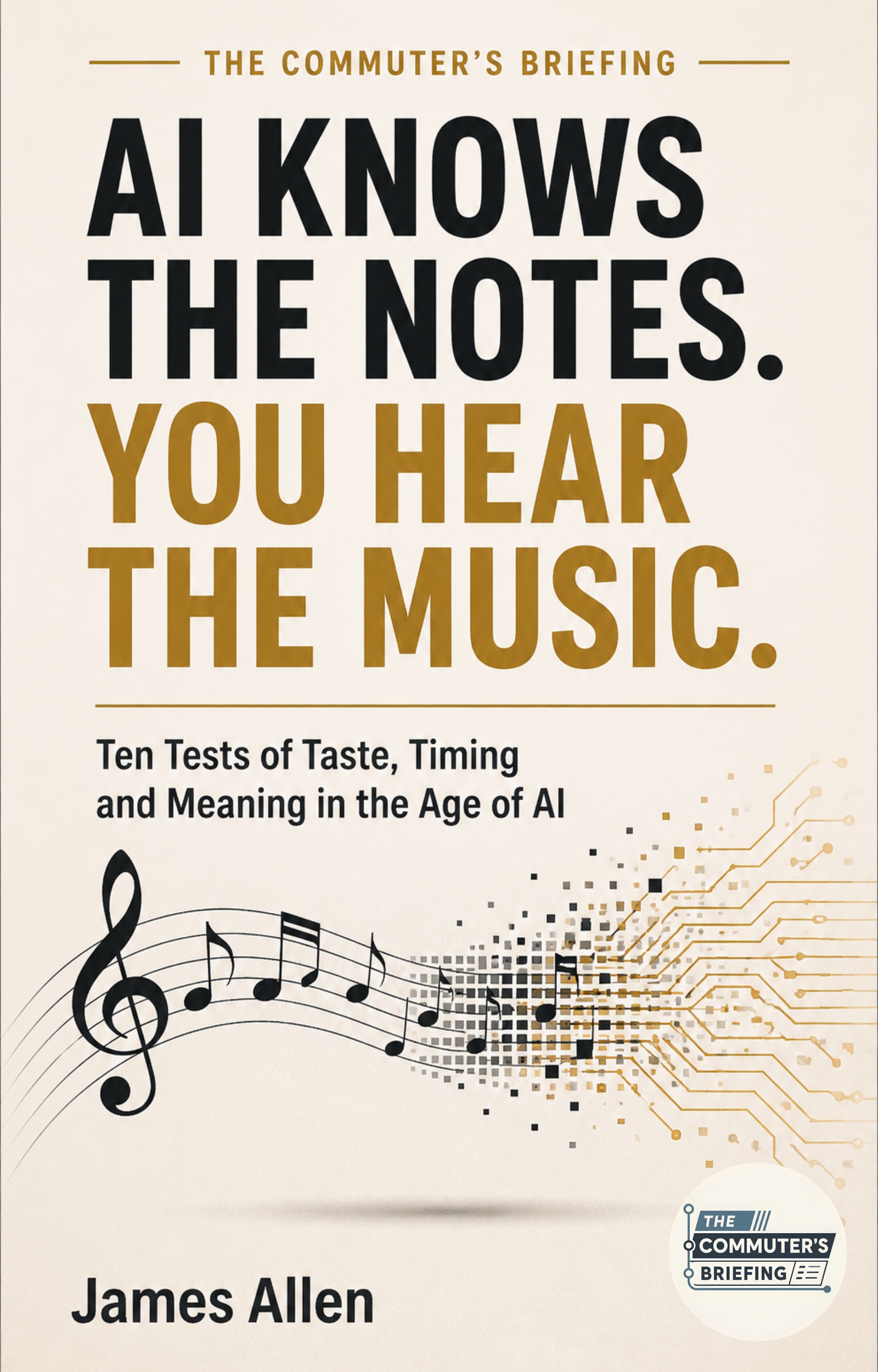
AI Knows the Notes. You Hear the Music — James Allen
A short Commuter's Briefing book about using AI without surrendering human judgement.
Through poetry, jokes, music, metaphor and workplace communication, it argues for a productive middle ground: neither rejecting AI nor treating its first answer as revelation.
The machine can generate possibilities.
You still have to decide which ones deserve to exist.
One Thing to Remember
The future advantage may not belong to the person who can produce the most answers, but to the person who knows which answers are worth keeping.
And there is something unexpectedly encouraging about that.
Because you have been practising this skill for years.
Every time you deleted a sentence because it sounded wrong.
Every time you ignored the obvious suggestion.
Every time you changed your tone because you knew the person receiving the message.
Every time you looked at something polished and thought:
No. We can do better than that.
AI has not made those instincts obsolete.
It may have made them considerably more valuable.
Your train is approaching the platform.
The machine can give you another hundred options before you get there.
You don't have to choose any of them.
📚 Today's Briefing Shelf
- A classicThe Art of Rhetoric — AristotleLong before anybody worried about algorithms, Aristotle was interested in the relationship between the speaker, the argument and the audience. His enduring point — that effective communication is about understanding who is listening and what a moment requires — is precisely the judgement that fluent AI prose so often lacks.
- An indieSeveral Short Sentences About Writing — Verlyn KlinkenborgA wonderfully unusual little book about paying attention to sentences. Its deeper lesson — stop assuming that because words arrive fluently they deserve to stay — becomes quietly radical when machines can produce enormous quantities of smooth prose.
- From the ImprintAI Knows the Notes. You Hear the Music. — James AllenA short Commuter's Briefing book about using AI without surrendering human judgement. Through poetry, jokes, music, metaphor and workplace communication, it argues for a productive middle ground: neither rejecting AI nor treating its first answer as revelation. The machine can generate possibilities. You still have to decide which ones deserve to exist.
💬 Conversation Starter
Has AI made us better at producing things — or merely quicker at reaching the first acceptable version?
James Allen · The Most Important AI Skill May Be Knowing When It's Wrong
The future advantage may not belong to the person who can produce the most answers, but to the person who knows which answers are worth keeping.
AI has not made those instincts obsolete.
It may have made them considerably more valuable.
Your train is approaching the platform.
The machine can give you another hundred options before you get there.
You don't have to choose any of them.