Monday BriefingFree · 8-minute read
The People Who Turn Up
Why the worst moments can reveal a larger world than fear allows us to see.
Behavioural Science
Briefing No. 09 · Decision Making
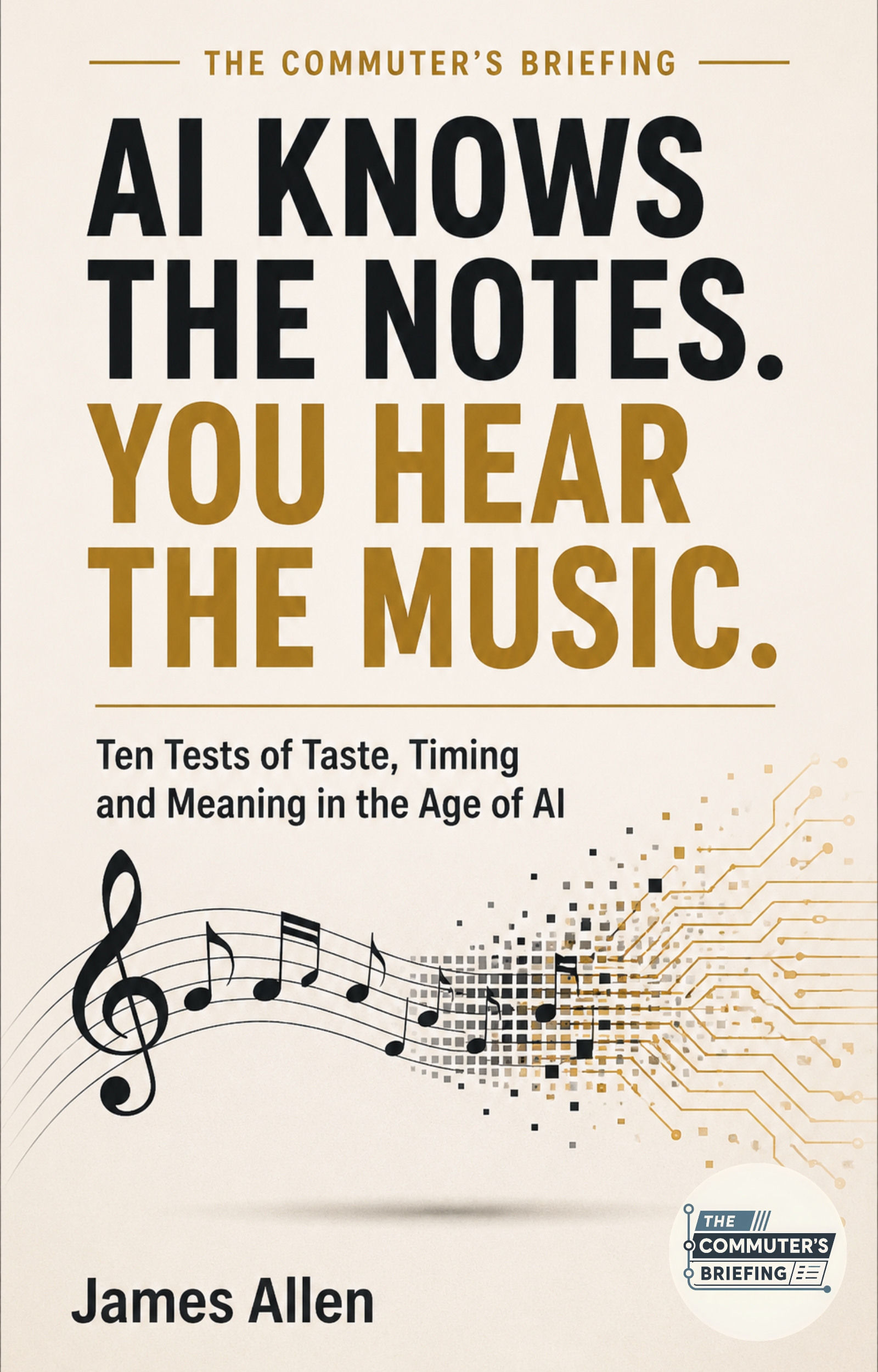
Ten Tests of Taste, Timing and Meaning in the Age of AI · 99 minute read (10 Chapters) · Kindle edition · £4.99
The Thesis
Artificial intelligence can now generate hundreds of polished answers in seconds. The scarce skill is no longer fluency. It is judgement. AI Knows the Notes. You Hear the Music is a witty, practical guide to the human abilities that become more valuable as machines become more capable: taste, timing, context, restraint and the instinct to recognise what deserves to survive. Across ten entertaining blind tests, you compare human and AI-generated poems, jokes, metaphors, messages and creative ideas. Guided by Aristoxenus — the ancient Greek thinker who argued that mathematics could identify the notes but only a listener could understand the music — each short chapter includes an ancient insight, a workplace application, a one-minute exercise and a sentence designed to make you sound remarkably well informed before 9:05. AI can join the orchestra. It should not decide what the concert is for.
A complete, thought-provoking read for £4.99—less than the price of a fancy coffee.
Buy on Kindle£4.99→Available exclusively as a Kindle ebook · Read on any device
Free Introduction
Your phone can identify a song after hearing three muffled seconds through the ceiling of a branch of Pret. This is impressive.
It can tell you the title, the artist, the year, the album and, presumably, which Scandinavian producer added the handclaps. It will offer you the lyrics, a link to purchase, and a list of songs that sound statistically similar. All of this happens faster than you can remember whether you wanted the tuna melt or the sad falafel.
What it cannot tell you is why the song makes you think of being nineteen, standing in a kitchen whose carpet should never have been allowed near food, believing that everybody in the room would remain your friend for life.
The machine has identified the notes.
You have heard the music.
This book is about the difference.
We are living through a peculiar moment. Artificial intelligence can now write poems, draft emails, generate jokes, compose marketing copy, summarize reports, and produce ten different versions of the same apology in the time it takes you to decide whether "sorry" needs a capital S.
This has triggered two equally tedious responses.
The first is apocalyptic: AI will destroy creativity, eliminate jobs, and turn us all into passive consumers of machine-generated sludge. The robots are coming for your livelihood, your art, and possibly your cat's Instagram account.
The second is evangelical: AI is a miracle tool that will liberate humanity from drudgery, democratize creativity, and allow everyone to become a bestselling author by lunchtime. Simply type a prompt, press enter, and watch as the machine does all the boring bits while you collect the applause.
Both responses miss the point.
The interesting question is not whether AI can produce competent sentences. It can. The interesting question is: now that machines can generate hundreds of plausible options in seconds, what becomes valuable?
The answer is judgment.
Not taste in the snobbish sense—knowing which wine pairs with venison or which font announces that you went to the right university. I mean judgment in the practical sense: the ability to recognize what fits, what matters, what has already been said too many times, and what ought to be quietly deleted before anyone notices.
As fluency becomes abundant, discernment becomes scarce.
That sentence is the heart of this book. And if you can drop it into a meeting before 9:15 tomorrow morning, you're already getting value for money.
Here's what this book is not.
It is not a technical guide to prompting. There are no instructions for making ChatGPT write like Hemingway, or tips for getting the perfect LinkedIn post in three tries, or hacks for tricking the algorithm into doing your homework.
It is not a warning that AI will destroy civilization. Civilization is doing a perfectly adequate job of that without algorithmic assistance.
It is not a celebration of human superiority. Humans are marvellous, but we are also the species that invented both the Cadbury Creme Egg and the meeting that could have been an email. We do not have an unbroken record of good decisions.
What this book is is a witty, practical argument that as machines become better at producing answers, human advantage moves towards deciding which answers are worth having.
It does this through ten short chapters, each built around a blind test.
You will compare two poems and decide which one you would remember tomorrow. You will read three jokes—one ancient, one modern, one generated by AI—and notice what makes you laugh and what makes you polite-smile. You will see the same message delivered to three different audiences and realize that context is the part of the prompt nobody remembered to type.
By the end, you will have learned ten practical ways to judge language, ideas, and creative work more intelligently. You will also have met a Greek philosopher who has been waiting more than two thousand years to say, "I told you so."
His name is Aristoxenus of Tarentum, and he is the intellectual guide for this book.
If you have not heard of him, do not worry. Neither had I until I went looking for someone from antiquity who understood that data is not the same as meaning.
Aristoxenus was a pupil of Aristotle and one of the most important music theorists of the ancient world. This was the fourth century BCE, when serious people were trying to explain why some combinations of sounds were beautiful and others made you want to leave the room.
The prevailing view, championed by the Pythagoreans, was that music could be understood through mathematics. A string twice as long produces a note an octave lower. Certain ratios—2:1, 3:2, 4:3—create harmonious intervals. Music, they argued, was fundamentally a matter of numbers. If you could measure it correctly, you could explain it completely.
Aristoxenus said: nonsense.
Not because the mathematics was wrong. The ratios were perfectly accurate. But, he argued, knowing the measurements does not mean you understand the music. A person who has never heard a melody cannot learn music from a diagram. You need both reason and perception. You need to hear what is happening now while remembering what came before. Music unfolds through time. It is not a pile of isolated notes; it is a structure that only makes sense when you experience it as a whole.
In other words: you can catalogue every note correctly and still fail to explain why the tune matters.
This makes Aristoxenus the perfect companion for a book about artificial intelligence.
Because AI is very, very good at cataloguing notes. It can analyze patterns, identify structures, calculate probabilities, and generate outputs that are statistically plausible. What it cannot do—yet, and possibly ever—is tell you why one version feels alive and another merely works.
That requires a human ear.
Let me be clear: I am not arguing that AI is incapable of creativity, or that machines will never produce something original, or that human beings will always remain superior.
Those arguments are not only arrogant; they are also boring. And they date badly. Every time someone declares that machines will never be able to do X, a research team in California builds something that does X before the article is even published.
The smarter argument is this: even if machines become extraordinarily good at generating options, someone still has to choose.
And choosing well is not a simple matter of preference. It requires context, memory, consequence, and an understanding of what has already been said, who is listening, and what might happen next.
It requires you to read the room, not just the prompt.
It requires you to know the difference between a sentence that is technically correct and a sentence that has something at stake.
It requires you to recognize when the most intelligent part of a message is where it stops.
These are human skills. Not because humans are magical, but because we have spent our entire lives learning to navigate a world made of other humans—people who misunderstand, take offense, tell jokes badly, remember the wrong details, and occasionally forgive us when we get it wrong.
Machines can simulate these things. They are getting better at it every month. But simulation is not the same as experience.
You know what it feels like to send an email and immediately regret it. You know what it feels like to tell a joke to the finance director and watch it land like a damp towel. You know what it feels like to realize, three sentences too late, that you have misread the room so badly that no amount of clarification will repair it.
That knowledge—awkward, hard-won, occasionally mortifying—is what makes you good at judgment.
This book will not make you better at using AI by teaching you clever prompts.
It will make you better at using AI by teaching you to trust your own judgment.
Each chapter is short—about six minutes. You can read the whole book in one journey, or five commutes, or ten minutes before bed when you are too tired for anything demanding but too awake to sleep.
Each chapter has the same structure:
By the end, you will have a practical philosophy for working intelligently with AI. Not by rejecting it, and not by surrendering to it, but by understanding what it does well and what it cannot do at all.
You will learn to ask better questions, choose better answers, and recognize when something that looks impressive is actually just expensive mediocrity.
You will also, I hope, enjoy yourself. Because this is not a book about the death of creativity or the rise of the machines. It is a book about why human judgment—your ability to notice what matters, what fits, and what ought to be quietly deleted—is about to become the most valuable skill you own.
AI can join the orchestra.
It should not decide what the concert is for.
Now: shall we begin?
Enjoyed the introduction? Read the rest of AI Knows the Notes. You Hear the Music. on Kindle.
Buy on Kindle£4.99→Put the idea to work
See how much of your working week currently uses judgement, expertise and human value.
Take the Workday Reset →Why the worst moments can reveal a larger world than fear allows us to see.
Behavioural Science
Not the usual business book list. Ten categories that actually matter when you're starting out — from understanding people to staying curious — with books worth carrying into the first year and beyond.
Behavioural Science
In the spring of 2025, while other people were using AI to improve productivity, I asked it to make coffee tables. The experiment became a book — and a record of the moment we stopped being astonished and started asking better questions.
Behavioural Science

