ArticleFree · 9-minute read
Manchester and Chicago Have More in Common Than Either Would Probably Admit
Two great second cities, two working mornings — and the peculiar pleasure of not living in the capital.
Behavioural Science
Briefing No. 02 · History
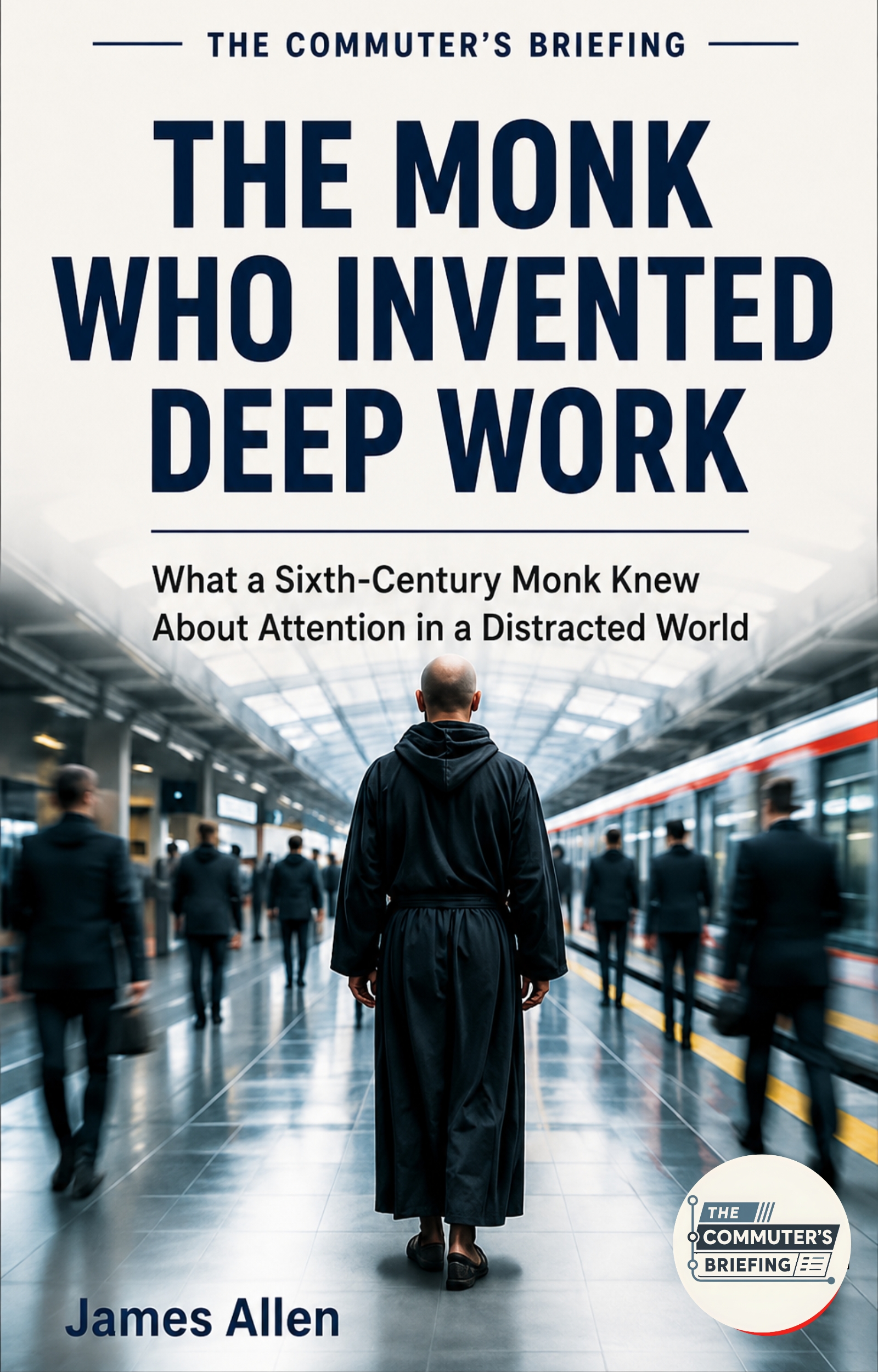
What a Sixth-Century Monk Knew About Attention · 50-minute read (5 parts) · Kindle edition · £4.99
The Thesis
What if a good deal of modern advice on focus was first worked out in the sixth century? Long before notifications, back-to-back meetings and the inbox that never empties, an Italian monk called Benedict wrote a rule for living that reshaped monasteries — and, in time, Western civilisation. His thinking on attention, rhythm and silence anticipates much of what we now reach for under the heading of productivity. If you have ever felt busy without making progress, this short book offers an older, steadier remedy. Through story, history and quiet reflection, it makes a case for why attention matters, why routine outlasts willpower, and why silence has always been a serious tool. Sometimes the freshest thinking is the oldest kind.
A complete, thought-provoking read for £4.99—less than the price of a fancy coffee.
Buy on Kindle£4.99→Available exclusively as a Kindle ebook · Read on any device
Try the idea first
Free Introduction
It's 6:47 AM. You're on the train. You've been awake for forty-three minutes and you've already checked your email six times.
Which is impressive, really, when you think about it. That's once every seven minutes. You're like a cuckoo clock, except instead of a cheerful bird, it's just you, staring at your phone, hoping something has happened in the last seven minutes that will make your life make sense.
Nothing urgent has happened. Nothing even interesting. Just the usual accumulation: a meeting invitation for Thursday (which is somehow both too soon and too far away), a reply-all chain about office supplies that now has seventeen responses and counting, three newsletters you subscribed to in moments of wild optimism and now can't be bothered to unsubscribe from because that would require clicking "unsubscribe" and then confirming you want to unsubscribe and possibly filling out a survey about why you're unsubscribing, and honestly, it's easier just to delete them forever.
Also: a Slack notification that someone reacted to your message with a thumbs-up emoji.
A thumbs-up emoji.
This is what passes for human connection now. Someone has looked at your words, processed them, and decided the appropriate response is a small digital thumb pointing upward. You feel a tiny dopamine hit anyway. This is what you've become.
You put your phone away. You're going to read. You brought a book specifically for this purpose. An actual book. With pages. You're very proud of yourself for this. You open it. You read three paragraphs.
Your phone buzzes.
You check it. It's nothing. It's literally nothing—just your phone reminding you that you have a phone. You return to the book. You've completely forgotten what you just read. The words are still there on the page, but they've lost all meaning. It's like trying to remember a dream. You start the page again.
The train pulls into a station. People get on. Someone sits next to you. Too close. Much too close. There are forty-seven empty seats on this train—you counted—and this person has chosen to sit directly next to you, in your personal space, smelling of coffee and something else you can't quite identify. Regret, possibly. Or Lynx Africa.
You shift in your seat. You check your phone again. Still nothing. You open your laptop instead, because at least that looks productive.
You have three projects due this week. You're behind on all of them. Not catastrophically behind—not the kind of behind where people send concerned emails or schedule "check-in meetings." Just the usual low-grade behind that's become your permanent state of being. Like tinnitus, but for your career.
You open the first document. You read what you wrote yesterday. It's not bad. It's not good either. It exists. It's words in an order. You start to edit. You change a word. You stare at it. You change it back. The original was better. Or was it? You can't tell anymore. You've looked at this sentence so many times it's stopped being language and started being just shapes.
You check your email.
A new message. Your manager wants to "sync up" about the project.
"Sync up."
What does that even mean? When did we stop saying "talk" or "meet" or "have a conversation" and start saying "sync up" like we're USB devices? You feel a small spike of anxiety. Is something wrong? Did you miss something? Is this about the thing you forgot to do last week that you're hoping everyone else has also forgotten?
You start composing a reply. You delete it. Too casual. You start again. You delete it. Too formal. You're overthinking this. You know you're overthinking this. You send something brief and professional: "Sure, happy to sync. When works for you?"
You immediately regret the tone. "Happy to sync." Who says that? You sound like a robot. A very eager robot. You consider sending a follow-up email to clarify that you're a normal human person, but that would make it worse. Everything makes it worse.
You return to the document. You've completely lost your train of thought. Which is ironic, because you're on a train. You check the time.
7:03 AM.
You've been "working" for sixteen minutes and you've changed one word and sent one email that you're now worried about. You have a full day ahead of you. Eight hours in the office. Meetings at 9:30, 11:00, 2:00, and 4:00. The gaps between meetings aren't long enough to do deep work, but they're too long to waste, so you'll fill them with email, Slack, and small tasks that feel productive but aren't. Tasks like organizing your task list. Or color-coding your calendar. Or reading articles about productivity.
You know this because you've done it every day for three years.
The train pulls into another station. More people get on. Someone's eating a bacon sandwich. You can smell it. You're hungry. You had coffee for breakfast. Just coffee. You tell yourself this is intermittent fasting. It's not. It's just poor planning.
You check your phone again.
This is the productivity trap.
Not that you're lazy. You're not lazy. You're the opposite of lazy. You're so not-lazy that you've installed seven different apps to help you be even less lazy, and now you spend twenty minutes a day managing the apps that are supposed to save you time.
Not that you're disorganized. You're extremely organized. You have systems. You have frameworks. You have a color-coded calendar that looks like a Mondrian painting. You have folders within folders within folders. You have a task management system that's so sophisticated you occasionally can't find your own tasks.
Not that you lack tools. You have all the tools. You've tried them all.
You've used the Pomodoro Technique. Twenty-five minutes of focused work, five-minute break. It worked brilliantly. For about a week. Then you started checking your phone during the five-minute breaks, which turned into ten-minute breaks, which turned into fifteen-minute breaks, which turned into just working with your phone next to you because what's the point of pretending you have self-control?
You've tried time-blocking. You spent an entire Sunday evening color-coding your calendar. Deep work in blue. Meetings in red. Admin in yellow. Email in green. "Thinking time" in purple, which felt very sophisticated and important. It looked beautiful. Like a very organized rainbow. It lasted three days. Then someone scheduled an urgent meeting in your deep work block. Then another. Then you stopped fighting it because fighting it made you look inflexible, and "inflexible" is the worst thing you can be in modern work culture. Worse than incompetent. Worse than late. You can be bad at your job, but you must be flexible about it.
You've tried the Eisenhower Matrix. Urgent/important, urgent/not important, not urgent/important, not urgent/not important. You spent an hour categorizing your tasks into four neat quadrants. You felt like a strategic genius. Then everything became urgent because that's how modern work operates. Everything is urgent. Everything is important. Everything is due yesterday. The matrix became useless. You still have it, though. In a drawer. Judging you.
You've tried Getting Things Done. The whole system. You bought the book. You read the book. You highlighted the book. You set up the system exactly as described. Capture, clarify, organize, reflect, engage. You maintained it for two weeks. You felt like you'd finally cracked the code. Then you had a busy week and the system collapsed like a soufflé in an earthquake and now you have a folder full of uncategorized tasks that you're genuinely afraid to look at because you know it will take an entire day just to process them, and you don't have an entire day, because you're too busy being busy.
You've tried app blockers. Freedom. Cold Turkey. Forest, where you grow a little digital tree if you don't use your phone, which is somehow both adorable and deeply depressing. You blocked Twitter, Instagram, news sites, anything that might distract you. You worked for ninety focused minutes. It felt amazing. It felt like being a functional human being. Then you needed to check something for work—something legitimate, something actually work-related—and you had to disable the blocker, and once it was disabled you forgot to turn it back on, and three hours later you'd read seventeen articles about things you don't care about and watched a video of a dog who'd learned to skateboard.
You've tried digital detoxes. A whole weekend without your phone. You put it in a drawer. You went for walks. You read books. Actual books. You had conversations with people where you looked at their faces instead of slightly past their faces while thinking about your phone. It was peaceful. It was lovely. You felt like a person from a simpler time. A time when people wrote letters and had attention spans.
You came back Monday morning and had 147 unread emails and twelve Slack channels with red notification dots and you spent three hours catching up and you were behind before you even started.
You've tried standing desks, treadmill desks, ergonomic chairs that cost more than your first car, blue-light-blocking glasses that make you look like a budget Bono, morning routines, evening routines, meditation apps that tell you to "just breathe" in a voice so calm it makes you anxious, productivity podcasts, books about productivity, courses about productivity, coaches about productivity who charge £200 an hour to tell you things you already know but aren't doing.
None of it worked.
Or rather: all of it worked for a little while, and then it didn't, and you felt like the problem was you. Like you weren't disciplined enough. Like you weren't optimizing correctly. Like if you just found the right system, the right app, the right framework, the right morning routine, the right evening routine, the right desk setup, the right notebook, the right pen—everything would click into place and you'd finally be productive.
You'd finally be the person you're supposed to be.
The person who has it all together. The person who responds to emails promptly. The person who never misses deadlines. The person who has time for deep work and strategic thinking and also goes to the gym and cooks healthy meals and maintains friendships and has hobbies and reads books and learns languages and somehow, somehow, isn't tired all the time.
But here's what nobody tells you.
Here's the thing that no productivity guru, no app developer, no life coach, no LinkedIn influencer posting about their 5 AM routine will ever admit:
The problem isn't that you haven't found the right system.
The problem is that you're trying to optimize the wrong thing.
Enjoyed the introduction? Read the rest of The Monk Who Invented Deep Work on Kindle.
Buy on Kindle£4.99→Want the complete briefing?
Read it on Kindle→Put the idea to work
See whether attention — or something else — is currently creating the most friction.
Take the Workday Reset →Two great second cities, two working mornings — and the peculiar pleasure of not living in the capital.
Behavioural Science
Why the worst moments can reveal a larger world than fear allows us to see.
Behavioural Science
What the Premier League can teach us about resetting after summer, changing one habit and returning to work with fresh energy.
Behavioural Science

