
Monday BriefingFree · 8-minute read
The People Who Turn Up
Why the worst moments can reveal a larger world than fear allows us to see.
Behavioural Science
Briefing No. 06 · Philosophy
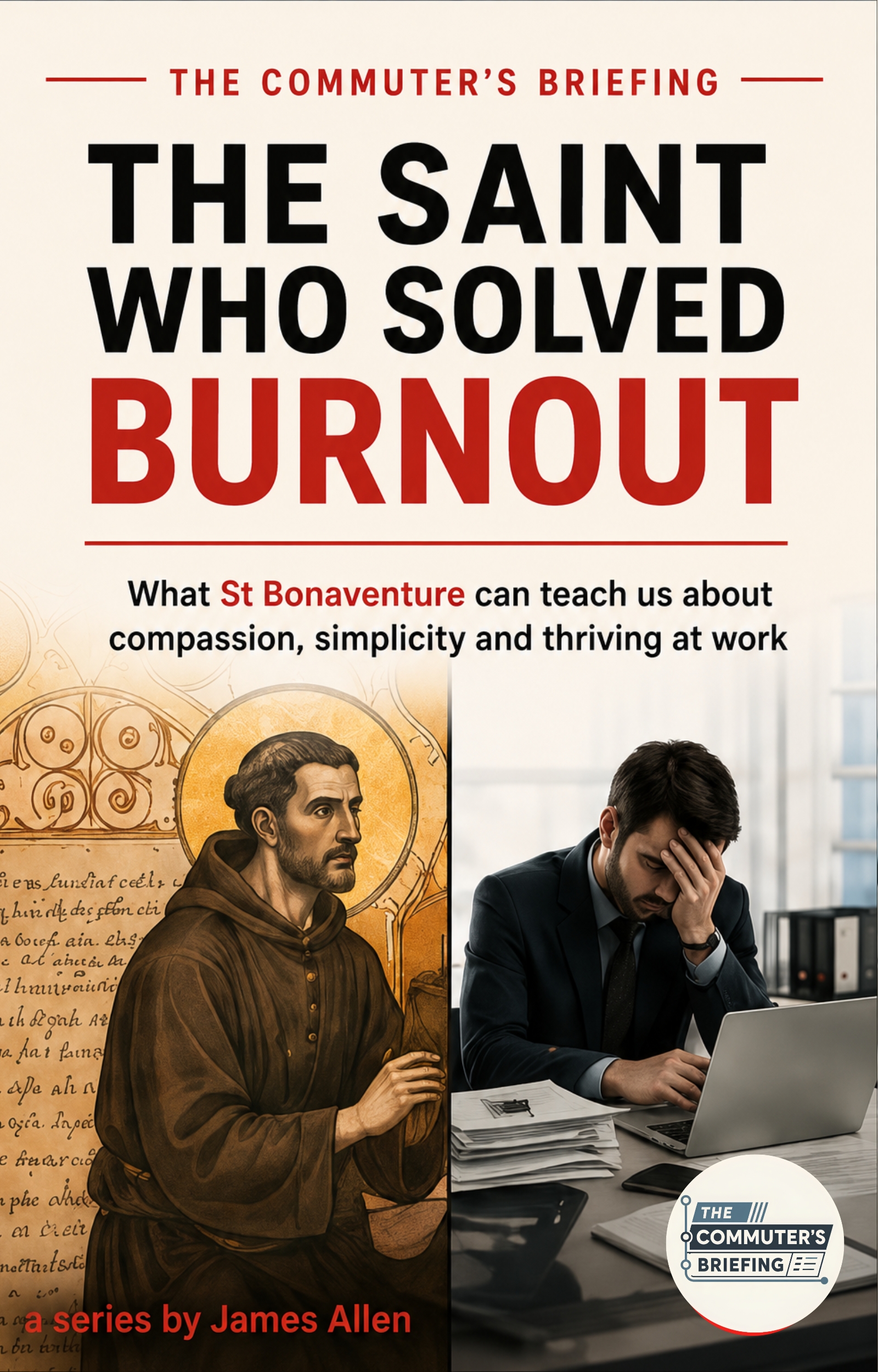
What St Bonaventure Can Teach Us About Compassion, Simplicity and Thriving at Work · 75 minute read (4 chapters) · Kindle edition · £4.99
The Thesis
Have you ever left work tired, and not quite sure what you finished? Eight hundred years ago a medieval friar called Bonaventure was thinking about the same difficulties we grapple with now: burnout, perfectionism, the pressure to succeed, the illusion that we can control everything. The striking thing is how practical his answers remain. The Saint Who Solved Burnout turns four of his ideas into usable wisdom: that compassion makes a stronger leader, not a softer one; that mercy loosens the grip of perfectionism; that simplicity reclaims your attention; and that letting go beats trying to hold everything together. An entertaining guide to thinking more clearly, working more wisely, and going home with a little more energy than you left with.
A complete, thought-provoking read for £4.99—less than the price of a fancy coffee.
Buy on Kindle£4.99→Available exclusively as a Kindle ebook · Read on any device
Free Introduction
I was standing in a meeting the other day when someone said, "Let's circle back and touch base offline to ideate some blue-sky thinking around our core competencies."
I nodded. Everyone nodded. No one knew what any of it meant.
Later, on the train home, I realized I'd spent eight hours in back-to-back meetings and hadn't actually done anything. Unless you count drinking terrible coffee and pretending to understand a pivot table. Which I don't.
This is modern professional life: exhausting, bewildering, and somehow both incredibly busy and utterly pointless at the same time. We're all running very fast on a treadmill we can't remember climbing onto. And occasionally someone shouts "synergy!" and we run faster.
The thing is, we know something's wrong. We feel it in our bones—or more accurately, in our necks, because we've been hunched over laptops for so long we're evolving into a new species. Homo Slackus. We're burned out, perfectionistic, drowning in stuff we don't need, and convinced that if we just work a bit harder, optimize a bit more, buy one more productivity app, we'll finally feel... what? Happy? Successful? Less like we're slowly being digested by a corporate entity?
So naturally, I turned to a thirteenth-century Italian friar for advice.
I know what you're thinking. "That's a bit niche, isn't it? What's next, asking Genghis Khan about work-life balance?"
But hear me out.
Saint Bonaventure—theologian, philosopher, and the only person in history to tell papal messengers to hang his cardinal's hat on a tree because he was busy doing the washing up—understood something we've forgotten. He knew that the things making us miserable aren't new problems with modern solutions. They're old problems we keep repackaging in different wrapping paper.
Burnout? That's what happens when you forget compassion—for others, but mostly for yourself.
Perfectionism? That's what happens when you've never learned mercy.
The endless accumulation of things you don't need? That's what happens when you've lost sight of simplicity.
And the exhausting illusion that you can control everything if you just try hard enough? That's what happens when you've never practiced renunciation.
Bonaventure wrote about all of this. Admittedly, he didn't call it "burnout." He called it "the soul's restlessness." But he was describing the same thing: that gnawing feeling that you're doing everything right and still somehow getting it all wrong.
The medieval world wasn't some peaceful, contemplative paradise. Bonaventure lived through political chaos, theological warfare, and the constant threat that his religious order would tear itself apart. He was Minister General of the Franciscans during a period when half of them wanted to live in caves eating berries, and the other half wanted to build universities and engage with the world. Imagine trying to chair that meeting.
And yet, he figured some things out. Things that are frankly more useful than most of what you'll read in the business section of WHSmith.
This book isn't about becoming a monk. (Though if you work in middle management, you've probably already taken a vow of suffering.) It's not about rejecting ambition or pretending you don't care about success. It's about four pieces of medieval wisdom that are surprisingly, almost annoyingly, relevant to modern professional life.
Compassion isn't weakness—it's what stops you from becoming the manager everyone secretly hates. You'll meet Marcus, a brilliant tech lead who's about to learn this the hard way.
Mercy isn't just for other people—it's the thing you desperately need to give yourself before perfectionism eats you alive. Sophie, a senior executive, is about to discover this on a particularly bad Tuesday.
Simplicity isn't deprivation—it's freedom from the exhausting tyranny of more. James, a successful consultant, owns seventeen pairs of nearly identical shoes and is deeply unhappy. Spoiler: the shoes aren't helping.
Renunciation isn't giving up—it's letting go of the illusion that you can control everything, which is the most liberating thing you'll ever do. Elena, a project manager with a color-coded spreadsheet for her spreadsheets, is about to find this out.
These aren't abstract theological concepts. They're practical tools. Medieval life hacks, if you will. Though Bonaventure would probably have hated that phrase. He'd have said something like "pathways to divine illumination through the mortification of disordered attachments," which is why I'm writing this book and he isn't.
The point is: you're already on a journey. Probably the 7:42 to Waterloo, or the Northern Line during that special time of day when you're pressed against a stranger's armpit questioning all your life choices. This book is designed for exactly that journey. Short enough to read in chunks. Practical enough to think about during your next pointless meeting. Funny enough—I hope—that you won't feel like you're being lectured by someone in a hair shirt.
Each chapter opens with a fun fact about Bonaventure's life, because it turns out medieval saints were more interesting than you'd think. Then we'll look at what he actually wrote, why it mattered in his time, and why it matters even more in ours. We'll meet people like you—professionals trying to navigate the beautiful mess of modern work life—and see how these ancient ideas play out in contemporary situations.
And then you'll get off the train, go to work, and probably sit through another meeting about "leveraging our bandwidth."
But maybe—just maybe—you'll do it with a bit more compassion, mercy, simplicity, and freedom than you had before.
Bonaventure would have liked that.
Though he'd have phrased it differently.
Enjoyed the introduction? Read the rest of The Saint Who Solved Burnout on Kindle.
Buy on Kindle£4.99→Put the idea to work
See whether capacity or direction is the real source of the friction.
Take the Workday Reset →Why the worst moments can reveal a larger world than fear allows us to see.
Behavioural Science
From BBC News to Rightmove, the nation's search box reveals a country that is anxious, curious, house-hunting and still pretending Wordle counts as intellectual exercise.
Behavioural Science
Beneath the screens, spreadsheets and passive-aggressive calendar invitations, much of office life would have been instantly recognisable to the ancient Greeks.
Behavioural Science

