ArticleFree · 6-minute read
Tom Holland Is Having the Best Year of His Life. Why Success Still Makes Us Want to Disappear for a While.
Getting what you wanted can be surprisingly exhausting.
Psychology
Briefing No. 07 · Communication
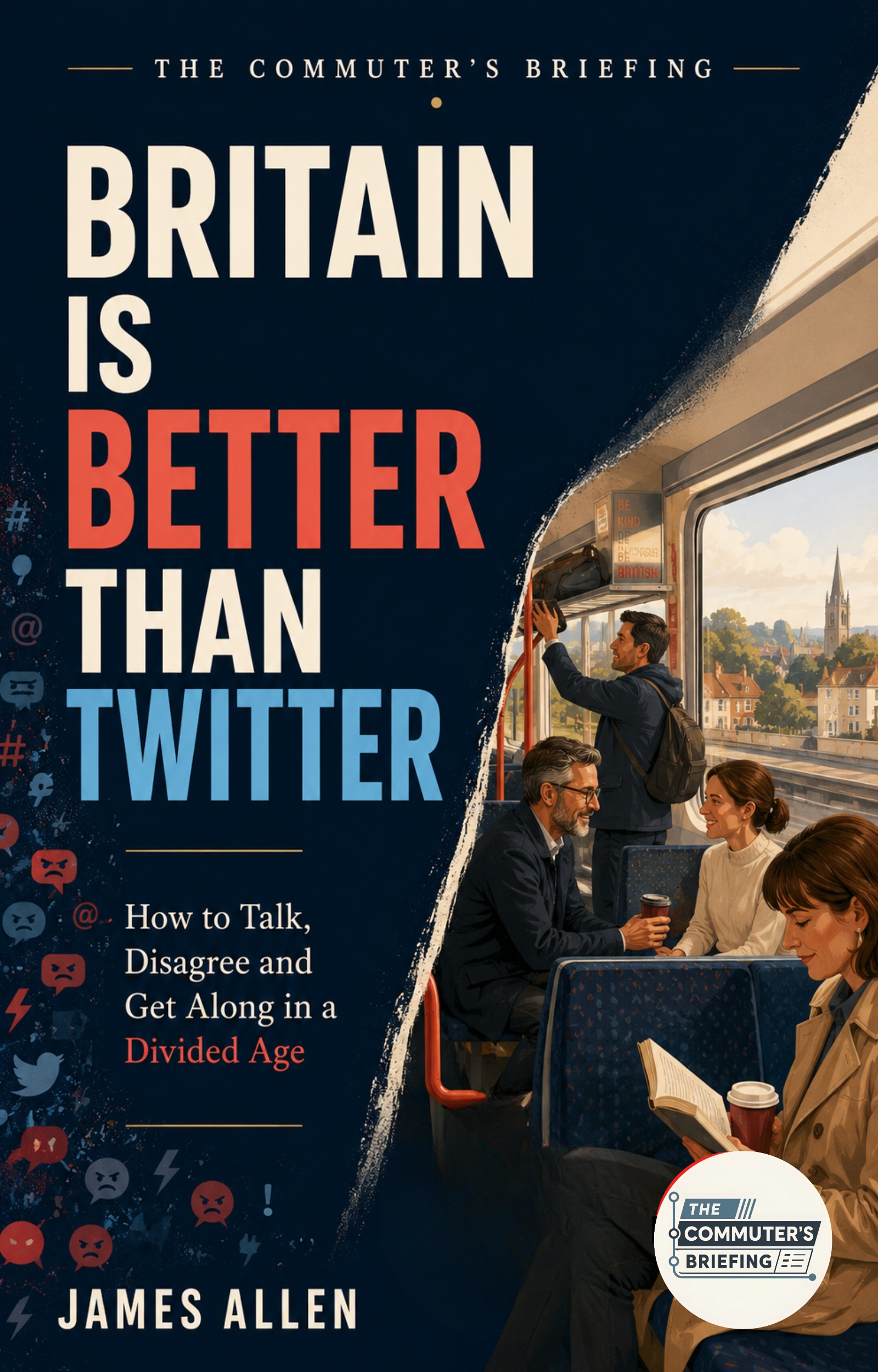
How to Talk, Disagree and Get Along in a Divided Age · 74 minute read (7 chapters) · Kindle edition · £4.99
The Thesis
Twitter says Britain is furious, divided and falling apart. Your morning commute suggests otherwise. Every day, strangers make room for buggies, hold doors, offer seats and make tea for colleagues they disagree with about politics — and nobody posts about it. Britain Is Better Than Twitter is a funny, thoughtful and quietly hopeful exploration of why real life is usually kinder than social media makes it appear, and how we can recover the lost art of talking to people with whom we do not entirely agree. Drawing on Joseph Addison and The Spectator — the eighteenth-century publication that turned London's coffee houses into places of curiosity, humour and civilised conversation — James Allen asks what those spaces can teach us about modern offices, divided politics and life online. Warm, witty and designed for busy readers, it offers a more human way to navigate work, conversation and disagreement in a divided age. Hold the door. Ask the question. Make the tea. Britain is better than Twitter — and so are most of the people you meet.
A complete, thought-provoking read for £4.99—less than the price of a fancy coffee.
Buy on Kindle£4.99→Available exclusively as a Kindle ebook · Read on any device
Free Introduction
The 7:42 from Clapham Junction is delayed by four minutes, which means approximately two hundred people are now standing on a platform designed for seventy. A woman with a buggy is trying to navigate through the crowd toward the ramp. Without anyone saying a word, the crowd parts. Someone holds a coffee cup higher. Someone else shifts a rucksack. A man in a suit picks up the front of the buggy to help it over a gap. The woman says thanks. The man says no worries. Everyone goes back to looking at their phones.
If you'd spent those four minutes scrolling through Twitter instead of watching the platform, you'd have concluded that Britain was on the brink of civil war. That we'd forgotten how to be civil to one another. That common decency had died sometime around 2016 and we were now just feral creatures screaming into the void, divided by everything, united by nothing.
But you didn't spend those four minutes on Twitter. You spent them on a delayed train platform, where two hundred strangers cooperated wordlessly to help someone with a buggy, and then went back to their lives without expecting a medal.
This happens approximately eleven thousand times a day in Britain, and approximately none of those times does anyone tweet about it.
This book is about that gap.
Here's the thing nobody tells you about social media: it's not a window onto the world. It's a funhouse mirror in a hall of funhouse mirrors, and all the mirrors are angled to show you the worst possible reflection of humanity, because that's what keeps you looking.
I'm not going to spend this entire book ranting about Twitter. (That would be boring, and also I'd have to spend more time on Twitter to research it, which sounds like hell.) But I do want to start with a simple observation: if you judged Britain purely by its social media presence, you would conclude that we are a nation of perpetually furious strangers who agree on nothing, trust no one, and spend our days firing off hot takes like we're in some kind of ideological paintball tournament where everyone's already covered in paint but we keep firing anyway because we've forgotten what we're aiming at.
And then you get off the train.
And someone holds the ticket barrier for you when your Oyster card doesn't work.
And someone in the office kitchen asks if you want a tea while they're making one.
And someone you've never spoken to before says "bless you" when you sneeze in the lift.
And you think: hang on.
I started noticing this gap about three years ago. I'd spend my commute reading Twitter, absorbing the general vibe that humanity was doomed and everyone was terrible and we'd lost the ability to have a civil conversation about anything. Then I'd arrive at work, where I'd spend eight hours with people I hadn't chosen, many of whom I disagreed with about quite important things, and somehow we'd manage to finish projects, make decisions, have meetings that didn't descend into fistfights, and—this is the bit that really confused me—we'd be nice to each other.
Not performatively nice. Not nice because we were being watched. Just... nice. Because that's what you do when you have to see someone again tomorrow.
Sarah in Accounts voted differently to me in every election since 2010. I know this because we've talked about it. We've even argued about it, in the way that people argue when they quite like each other and know they'll both still be there when the argument's over. And yet, somehow, Sarah still remembers that I take my coffee black with no sugar. And I still hold the door for her when she's carrying files. And neither of us has denounced the other on social media as a traitor to civilization.
This is not because we're unusually virtuous people. This is because we're normal people, operating in a normal environment, where cooperation is rewarded and outrage is exhausting.
Twitter is not a normal environment.
The average British office is a minor miracle of cooperation. Think about it: you've got twenty, fifty, two hundred people who didn't choose each other, who don't agree on politics or religion or whether it's acceptable to heat fish in the microwave (it isn't, Claire), and yet somehow they manage to coexist. They share kitchens. They share printers. They remember each other's birthdays. They chip in for leaving cards for people they barely know.
Nobody agrees on everything. But the tea gets made anyway.
This is not a small thing. This is civilization.
And it's almost entirely invisible to social media, because social media is designed to show you the exceptions, not the rule. The person who didn't hold the door. The meeting that did descend into chaos. The colleague who was unreasonable. These things happen, obviously. But they're not the norm. They're just the only things interesting enough to tweet about.
The result is that we're all walking around with two completely contradictory pictures of humanity in our heads. There's the Twitter version: everyone's awful, everything's broken, we're all doomed. And there's the actual version: most people are fine, most things work, we'll probably muddle through.
The problem is, we're starting to believe the Twitter version.
This matters more than you might think.
If you believe that everyone's awful, you start treating people like they're awful. If you believe that cooperation is impossible, you stop trying to cooperate. If you believe that we've lost the ability to have civil conversations, you stop having them.
And then the Twitter version becomes a self-fulfilling prophecy.
But here's the good news: it's not true. Britain is not Twitter. The office is not Parliament. The average commuter is significantly kinder than the average comment section. We know this because we live it, every single day, in a thousand tiny interactions that never make the news.
The question is: how do we remember that?
This is where Joseph Addison comes in.
If you've heard of Addison at all, it's probably because you had to read him in school and found him deeply boring. I apologize on his behalf. Eighteenth-century prose is an acquired taste, like Marmite or cricket.
But here's what Addison understood, and what we've forgotten: conversation is a skill. Civilization is a practice. And both of them require actual human beings, in actual rooms, treating each other like actual human beings.
Addison and his mate Richard Steele ran a publication called The Spectator in the early 1700s. It was basically a blog, except printed on paper and delivered by a man on a horse. And its entire purpose was to teach people how to have better conversations.
Not arguments. Not debates. Not hot takes. Conversations.
The kind where you're actually interested in what the other person thinks, not just waiting for your turn to talk. The kind where you ask questions because you want to know the answers, not because you're setting up a gotcha. The kind where you might—brace yourself—change your mind about something.
Addison's world was the coffee house. Ours is the office. But the principle is the same: put people in a room together often enough, and they'll figure out how to get along. Not because they're saints, but because cooperation is easier than conflict when you have to see someone again tomorrow.
Social media has no tomorrow. That's the problem.
This book is not a manifesto. I'm not going to tell you to delete your Twitter account or throw your phone in a river or move to a commune in Wales. (Though if you do move to a commune in Wales, please send pictures. I hear they're lovely.)
This is a book about noticing. About paying attention to the Britain that actually works, rather than the Britain that Twitter says is broken. About recovering the lost art of being interested in other people, not because it'll make you a better person (though it might), but because it'll make you a more interesting person to be around.
And it's about remembering that civilization isn't something that happens to us. It's something we do, every day, in small ways, mostly without thinking about it.
Someone holds a door. Someone makes a tea. Someone says bless you in a lift.
Britain is better than Twitter.
Not because Britain is perfect.
But because everyday life rewards cooperation far more than outrage.
And that, as it turns out, makes all the difference.
Enjoyed the introduction? Read the rest of Britain Is Better Than Twitter on Kindle.
Buy on Kindle£4.99→Put the idea to work
See how communication is functioning in your working week.
Take the Workday Reset →Getting what you wanted can be surprisingly exhausting.
Psychology
Spider-Man, the Roman Empire and why the wrong person sometimes gets the credit at work.
Psychology
What the Premier League can teach us about resetting after summer, changing one habit and returning to work with fresh energy.
Behavioural Science

