ArticleFree · 9-minute read
Manchester and Chicago Have More in Common Than Either Would Probably Admit
Two great second cities, two working mornings — and the peculiar pleasure of not living in the capital.
Behavioural Science
Briefing No. 10 · Workplace
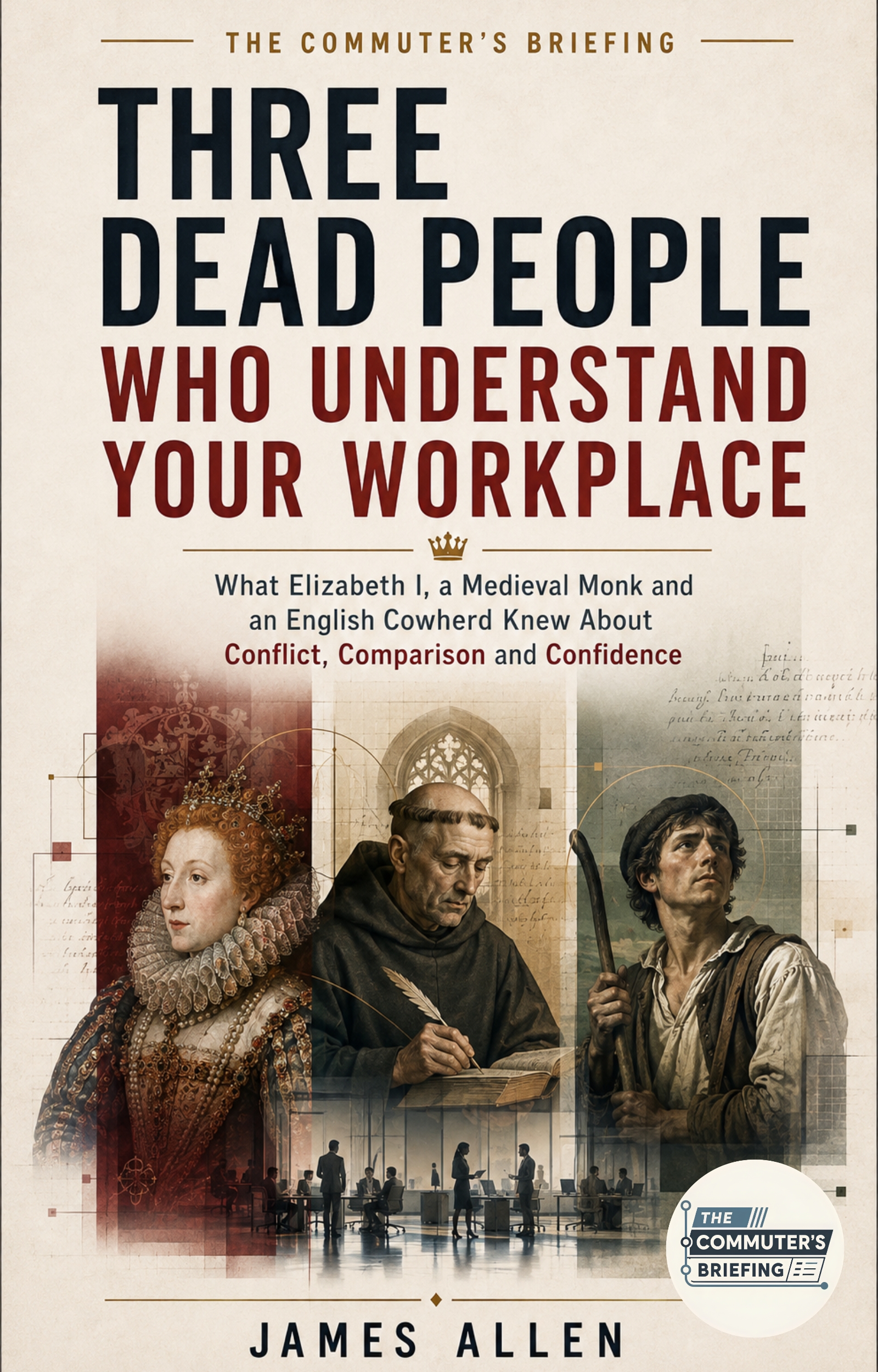
What Elizabeth I, a Medieval Monk and an English Cowherd Knew About Conflict, Comparison and Confidence · 89 minute read (15 parts) · Kindle edition · £4.99
The Thesis
Three people have followed you to work: the colleague who turns simple decisions into constitutional crises, the former acquaintance announcing dazzling promotions on LinkedIn, and the voice in your own head suggesting everyone else knows what they are doing. These are the three great pressures of professional life — conflict, comparison and confidence. Fortunately, history has already met them. In this witty and practical briefing, James Allen introduces three unexpected guides: Elizabeth I, who refused to be trapped between bad choices; Bernard of Cluny, the medieval monk who discovered that even people who had renounced wealth still competed over status; and Cædmon, the English cowherd who left the room whenever the singing began — before becoming the earliest English poet whose name survives. Create a third option. Question the scoreboard. Begin before confidence arrives. Elizabeth, Bernard and Cædmon cannot come to work with you tomorrow. Their better ideas can.
A complete, thought-provoking read for £4.99—less than the price of a fancy coffee.
Buy on Kindle£4.99→Available exclusively as a Kindle ebook · Read on any device
Try the idea first
Free Introduction
It is 8:43 on a Monday morning, and three people have followed you into the office.
The first is the colleague who makes every simple decision feel like an inquiry chaired by a disappointed judge. They do not openly disagree. That would almost be refreshing. Instead, they ask "just one quick question" that takes twenty minutes, agree to the plan in the meeting, then send a message afterwards explaining why the plan cannot possibly work. You have tried being patient. You have tried being direct. Nothing has helped.
The second person is not physically present. They are on LinkedIn.
They have just announced a promotion to Global Head of Something Important at a company whose name contains no vowels. The photograph shows them smiling confidently beside a glass wall. They are "humbled", naturally. The post has 642 likes. You once shared a student kitchen with this person and watched them attempt to boil an egg without water.
You are pleased for them.
You are also suddenly dissatisfied with every decision you have made since 2009.
The third person is you. Or, more precisely, the version of you who sits at the back of your mind during important meetings and whispers that everybody else has understood something you missed. This voice becomes particularly active whenever somebody says "as you all know".
You do not know.
You are beginning to suspect that your career has been an administrative error that will shortly be corrected.
These three problems — conflict, comparison and confidence — account for a surprising amount of professional anxiety.
We struggle with difficult people. We compare ourselves with apparently successful people. Then we wonder whether the difficult and unsuccessful person might, in fact, be us.
Modern work has developed an impressive vocabulary for these experiences: stakeholder management, professional visibility, personal branding, psychological safety, impostor syndrome. Much of the advice is useful. Some of it is merely the word "authenticity" printed beside a photograph of a mountain.
This book takes a different route.
Instead of asking the latest leadership expert how to survive the office, we are going to ask three dead people.
The first is Elizabeth I, who spent forty-five years surrounded by advisers, rivals, religious factions and foreign powers attempting to force her into choices that suited them.
Protestant or Catholic. Marriage or isolation. War or humiliation.
Elizabeth became exceptionally skilled at recognising when two apparent options were both traps. Her answer was the via media: not timid compromise, but a deliberate refusal to let other people define the limits of the decision.
This may prove useful the next time somebody says:
"We can either rush this through today or abandon the project entirely."
The second is Bernard of Cluny, a twelfth-century monk who discovered that withdrawing from ordinary society does not cure status anxiety.
The monks had renounced money, fashion and conventional careers. They then competed over rank, holiness, austerity and who appeared least interested in competing.
Bernard watched people perform humility while monitoring everybody else's progress. He responded by writing thousands of lines of Latin poetry about vanity, comparison and the exhausting human need to know where we stand.
Had LinkedIn existed in 1140, Bernard would have understood it immediately. He might even have posted daily, which would rather prove his point.
The third is Cædmon, a seventh-century cowherd who left the room whenever the harp was passed around because he believed he could not sing.
He was not trained or visibly destined for literary greatness. Yet he became the earliest English poet whose name survives.
His story offers something more useful than "believe in yourself". Cædmon did not begin because he felt confident. Confidence, if it came at all, arrived after he began.
These are not perfect heroes. Elizabeth could be evasive. Bernard was hardly immune to the status games he criticised. Cædmon's story reaches us through a religious account shaped by its own purposes.
We are not looking for saints to imitate line by line.
We are looking for patterns.
That is the value of historical wisdom. It does not tell us that the past was simpler or nobler. It reminds us that our supposedly unprecedented problems often have ancient psychological roots.
Technology changes the scenery.
Human beings keep bringing the same anxieties onto the stage.
Across the three parts of this book, you will learn three practical moves.
When somebody offers you two bad choices, create space for a third.
When somebody else's success makes your own life feel smaller, question the scoreboard before questioning your worth.
When you feel unqualified to begin, stop waiting for confidence to issue formal permission.
This will not fix your manager, remove LinkedIn from your phone or guarantee that you never again nod thoughtfully at an acronym you do not understand.
It offers something more modest: three stories, three mental models and three sentences worth carrying into the office.
Conflict. Comparison. Confidence.
Elizabeth refused the false choice. Bernard noticed the status game. Cædmon sang before he knew he could.
One of them should be useful before lunch.
Enjoyed the introduction? Read the rest of Three Dead People Who Understand Your Workplace on Kindle.
Buy on Kindle£4.99→Want the complete briefing?
Read it on Kindle→Put the idea to work
See whether interaction is helping or hindering your working week.
Take the Workday Reset →Two great second cities, two working mornings — and the peculiar pleasure of not living in the capital.
Behavioural Science
Why the worst moments can reveal a larger world than fear allows us to see.
Behavioural Science
What the Premier League can teach us about resetting after summer, changing one habit and returning to work with fresh energy.
Behavioural Science

