
Monday BriefingFree · 8-minute read
What Jane Austen Knew About Office Relationships
Sense, sensibility and the strange fact that offices can start to feel like families.
Workplace
No. 30 · 26 October 2026 · Free · 7-minute read
On darker evenings, finding your seasonal rhythm, and a new six-week celebration of independent authors.
The clocks went back yesterday. Most of our devices managed this quietly, without supervision. The oven is awaiting a small parliamentary committee.
There is something wonderfully optimistic about calling it an “extra hour”. An hour in which we might sleep, read, think or finally deal with that drawer. Somehow, it usually disappears into the ordinary business of being alive.
But the more interesting change arrives afterwards. The first weekday journey home in darkness. The curtains drawn earlier. The discovery that half past five can now feel suspiciously like bedtime.
For me, this is when reading begins to take up more room.
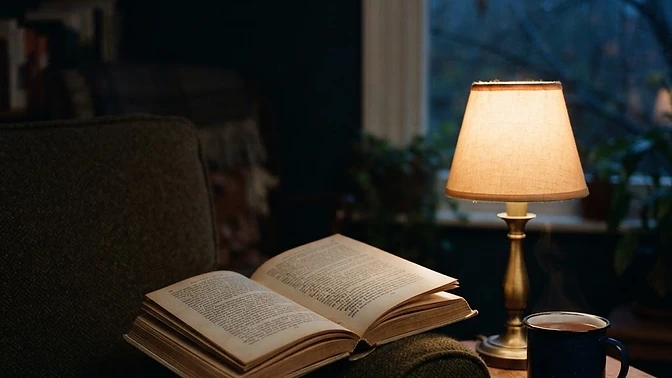
I prefer reading by the calm light of a lamp. A small pool of artificial light, a book, the rest of the room allowed to mind its own business. Summer evenings keep suggesting that I should be outside, making something of them. Autumn is more willing to let me sit down.
The Big Idea: notice what the season makes easier
We talk about habits as though they ought to operate identically throughout the year. Same morning routine. Same evening ambitions. Same person, delivering the same results, regardless of what is happening beyond the kitchen window.
Yet our days have texture. A bright evening invites one sort of activity; rain against a dark window invites another. The clocks changing makes that difference suddenly harder to ignore.
My reading habit strengthens at this point in the year without a stern conversation about self-improvement. The circumstances become more inviting. The lamp goes on. The book is there. I want to pick it up.
That seems worth noticing.
Perhaps you find autumn better for cooking, repairing things, writing, or ringing someone you have been meaning to ring. Perhaps you feel the loss of evening daylight sharply, and what matters most is protecting a lunchtime walk. There is no obligation to find the early darkness charming.
The useful question is personal: what becomes easier for you now, and what needs a little more care?
It is a question we could take to work.
Where we have some choice over our diaries, we might pay attention to when we think clearly, when conversation helps, and when another hour staring at a document produces only increasingly elaborate changes to the first sentence.
Working to your strengths includes noticing the conditions in which those strengths show up.
You might do your best thinking after getting outside. You might find a quiet late afternoon useful for careful editing. You might need to put the difficult task earlier and stop expecting a tired version of yourself to perform miracles at four thirty.
Of course, trains, children, customers and managers have their own views about our preferred rhythms. Few of us can redesign a working day around a particularly promising patch of sunlight. But even a small adjustment can be worth making.
This week, try noticing one thing before trying to improve it. When does your attention settle? What helps it stay? What are you doing when the day feels a little less like an argument?
The calendar can tell us when to turn the clocks back; it cannot tell us what to turn towards.
Books Clocked: six weeks of independent voices
This week also begins Books Clocked, a six-week feature in which I’ll be reviewing work by independent authors.
There is pleasure in finding a book that has reached you through someone’s enthusiasm. A recommendation passed across a table. A writer encountered online. A story you might otherwise have walked straight past.
Over the coming six weeks, I want to make space for those discoveries. We begin with a father, a child, and the imaginative possibilities of bedtime.
Today’s Briefing Shelf
*A classic: The Wind in the Willows — Kenneth Grahame*
Beyond Toad’s considerable difficulties with self-regulation, this is a book deeply attentive to the seasons. Winter brings Rat indoors, where poetry, small domestic tasks, visitors and stories of the summer fill his days. Returning to it as an adult, I find that rhythm part of its appeal: the world changes, and life along the riverbank changes with it. A fitting companion for an evening under a lamp.
*An indie — and our first Books Clocked choice: Jonathan’s Tales — Tom Kissack*
Tom Kissack’s Jonathan’s Tales are delightful: a wonderful, heartfelt collection of children’s stories from a father in tune with the imagination of the child in all of us.
Their origins make that description especially apt. In his foreword to the first volume, Tom describes telling stories to his young son at bedtime, recording them on his phone and later turning them into written tales. His son helped supply the starting ideas and sometimes responded enthusiastically as the stories unfolded; on other evenings, sleep arrived before the ending.
That is a lovely beginning for a book. A parent making time. A child offering an improbable possibility. A story growing between them.
What I value here is the warmth: the sense of a father taking a child’s imaginative life seriously. These are stories to enjoy together, and a reminder that adulthood need not mean losing touch with the part of us willing to wonder what happens next.
As the evenings draw in, that feels like a good place to begin.
Buy Jonathan’s Tales on Amazon · Find Tom on Instagram
*From the Imprint: Still Right***
Alongside this week’s stories, I’m putting Still Right on the shelf—and carrying its title into a seasonal question.
How often do we cling to a routine because it suited an earlier version of our circumstances? We decided what worked. We built a timetable around it. Then the light changed, the workload shifted, or life quietly rearranged itself.
There is room to reconsider. Something can have served us well without needing to serve us forever.
Perhaps that is part of what stories offer, too: practice in noticing change. Weather arrives. People grow. Someone sees a familiar place differently. We follow along, and remember that our own lives have seasons.
The Big Idea
The calendar can tell us when to turn the clocks back; it cannot tell us what to turn towards.
☕ Conversation Starter
What do you find yourself doing more of when the evenings draw in—and is it something you would like to make room for deliberately? Reading counts. So does making soup. So does admitting that you have never once enjoyed running in November.
James Allen · No. 30 — Clocks back. Books clocked.
📚 Today's Briefing Shelf
A little light for the journey
This week, put a book beside the chair where you actually sit. Switch on the lamp you like. Read a few pages yourself, or read them aloud to someone who still believes you can do all the voices.
There need be no target. No winter reading challenge. Nobody needs to turn the armchair into a performance review.
Just a story, and a little room for it.
Clocks back. Lamp on. Another chapter.
The Monday Briefing
Free · Five minutes · Unsubscribe anytime.
Free · Every Monday · Unsubscribe anytime · Privacy
Sense, sensibility and the strange fact that offices can start to feel like families.
Workplace
A psychology-inspired personality quiz based on five Jane Austen characters — Elizabeth Bennet, Elinor Dashwood, Marianne Dashwood, Emma Woodhouse and Anne Elliot.
Behavioural Science
Andy Burnham, the Great North Run, and the quiet business of staying yourself.
Psychology
Enjoyed this briefing? Follow @booksbyjamesallen for shorter ideas between Mondays.
Follow @booksbyjamesallen
