Psychology · Career · Quiz
What Did You Want to Be When You Grew Up?
Tell us what you dreamed of doing as a child and what your working life looks like now. We'll look for the surprising ways your younger self may still be at work.
By James Allen · 24 September 2026

Ask a room of adults what they wanted to be at seven years old, and watch the room become briefly honest. A marine biologist. A footballer. A vet. A pirate. Someone's mum. The person who drives the digger. A palaeontologist, because of a book. An astronaut, because of a film. A wizard, because of another film.
Then ask the same room what they actually do now. A procurement manager. A teaching assistant. A person who sorts out other people's spreadsheets and is too polite to say so. A midwife who once wanted to be a ballerina. A software developer who wanted to be a chef and now, on weekends, cooks extraordinarily ambitious meals for ungrateful teenagers. A marketing director who wanted to be a firefighter and, if you watch carefully at work, still sort of is.
The funny thing is not that the dream and the job rarely match. The funny thing is that they rarely match and something of the dream often survives anyway, wearing different clothes and using a different job title.
Before reading on, have a go yourself. Tell us what you wanted to be, what appealed about it, and what your working life looks like now. We'll look for the overlap — honestly, and without telling you whether you've succeeded in life, because that is not ours to decide.
The Reason Matters More Than the Title
Here is the central idea, and it is worth pausing on.
A child who says they want to be a vet is not really saying they want to spend eight years qualifying and then spend a career being sneezed on by anxious labradors. They are saying something about a wish. The wish might be to look after something smaller and more vulnerable than themselves. It might be to understand how a living body works. It might be to be the person everyone is glad to see walk into the room.
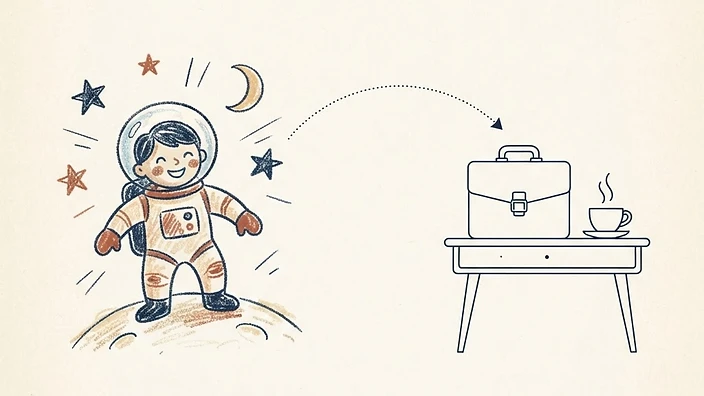
A child who says they want to be an astronaut is rarely committed to the specific career path of an astronaut, which involves a great deal of waiting and some deeply undignified fitness tests. They are expressing a wish to go somewhere no one has been, to see the whole thing from a distance, to find out what is out there.
The job title changes. The wish underneath it often doesn't, not entirely. And that wish — to discover, to help, to build, to perform, to lead, to protect, to explain, to make something beautiful — is a remarkably durable thing. It tends to find a way to express itself, even when the job description on the business card would make your seven-year-old self stare in quiet disappointment.
This is why asking what appealed about it is so much more interesting than asking what the job was. The job is a label. The appeal is a fingerprint.
What Did You Want to Be When You Grew Up?
About three minutes. No account, no email, no judgement. Tell us your dream, tell us your now, and we'll look for what survived.
When you were little, what did you want to be?
Whatever comes to mind. A job, several jobs, something invented, or just 'I don't remember' — all fine.
Your answers are used only to produce your result on this page. We don't store them, publish them, or ask for your email. Nothing you type leaves your screen except a brief reading by our AI to write your reflection.
What Survives When the Job Title Changes
The interesting examples are never the obvious ones. They are the ones where the surface changed completely and something underneath carried on.
The child who wanted to be a detective — to find things out, to notice what others missed — and is now a data analyst, quietly delighted by an anomaly in a spreadsheet that nobody else would think to look at. The dream didn't die. It learned SQL.
The child who wanted to be a teacher and is now a nurse. The job title moved. The wish — to explain, to reassure, to be the person who helps someone understand what is happening to them — stayed exactly where it was.
The child who wanted to be a famous footballer and now coaches an under-12s side on a wet Saturday morning. The stadium got smaller. The wish to perform, to lead, to be part of a team did not.
The child who wanted to be an artist and now designs presentations for a consultancy. The canvas shrank to a slide. The wish to make something look right, to arrange things so others can see what you see, is still there, and is still quietly frustrated by the colour palette the corporate template permits.
The child who wanted to run a shop and now runs a busy hospital ward. The shop became a department. The wish to keep things in order, to know where everything is, to be the person others ask when they can't find something — that wish is having a wonderful time.
The child who wanted to be a veterinarian and now works in retail, but is, unmistakably, the person every colleague brings their problems to, including the colleague who is, in fact, the department's anxious labrador. The wish to care found a way.
The child who wanted to be a writer and now is one — but in a marketing department, which is not what they meant at all, and is also, if they are honest, not entirely not what they meant. For more on why the work we end up in is rarely the work we pictured, the gap between intending and doing is a good place to wander.
The person who wanted to be several things at once — and now is. Self-employed, doing a bit of teaching, a bit of making, a bit of caring for a parent. The job title is a shrug. The wishes are all present and correct, just spread across a week rather than printed on a card.
When the Dream Really Did Leave
Not every story is a tidy one of continuity. Sometimes a childhood dream genuinely fades, and the honest thing to say is that it faded — not to dress up the gap as a hidden connection.
The child who wanted to be an explorer and now finds travel exhausting. The child who wanted to be a musician and stopped playing at fourteen and doesn't especially miss it. The person whose working life is, at the moment, simply not very satisfying, and whose childhood self would be mildly concerned to see what the weekdays look like now.
These are not failures. They are lives. People change. A wish that belonged to a seven-year-old does not have a permanent claim on a forty-three-year-old. The interesting question is not always "what survived?" Sometimes the more interesting question is "what did I let go of, and was I right to?"
The quiz is built to say that honestly. A low score is not a low mark. It might be the most useful thing you read all week — a prompt to ask whether something you used to want has quietly gone missing, and whether you'd like it back. For a longer look at why clever people still make choices they later regret, the connection between childhood wishes and adult decisions runs deeper than it looks.
What the Quiz Does — and Doesn't
The quiz asks what you wanted to be, what appealed about it, and what your working life looks like now, then a few short questions about what you actually spend your time doing, what you find satisfying and what matters to you.
Our AI reads your answers and looks for underlying themes — curiosity, service, creativity, adventure, expertise, independence, recognition, order and connection — in both your childhood dream and your present life. Your own explanation of what appealed about the dream is given more weight than any assumption about the job title. The percentage reflects how much the two sets of themes overlap. It is a playful reflection, not a scientific assessment, and it is labelled as such.
It does not ask for your employer, your salary, your age or your email. Your answers are used only to produce your result on this page. They are not stored or published. If the analysis can't find much to go on — because you wrote "I don't remember," or because your answers were honest about being unsure — it will say so, rather than inventing a confident number.
If you're between jobs, caring for someone, studying, retired early or doing several kinds of work at once, you are not a corner case here. You are the main event. The quiz is built for the way working life actually looks, not the way it looks on a CV.
The Wish Is a Fingerprint, Not a Verdict
The reason all of this matters is not that childhood dreams are sacred. They are not. A seven-year-old's career plan is not a binding contract.
It matters because the wish underneath the dream is often the clearest statement you ever made about what you find worth doing — before the world taught you to want the things it had on offer. Before the salaries, the security, the sensible choices, the rent. Before someone explained, patiently, that palaeontology wasn't really an option.
That early wish is worth checking against, every so often. Not to judge your present life against it. To check whether the thing you most wanted to do — discover, help, build, perform, lead, protect, explain, make things beautiful — still has somewhere to live in your week. And if it doesn't, to decide whether that's a relief or a quiet hint.
For more on why changing and still staying yourself is one of the quiet skills of a working life, that Monday Briefing is a good companion. And if you'd rather find something short to read on the subject — tell the Commuter Concierge how long you've got and it'll point you at the right thing.
From the Imprint
Three Dead People Who Understand Your Workplace
What Elizabeth I, a Medieval Monk and an English Cowherd Knew About Conflict, Comparison and Confidence
By James Allen
One of the quiet pressures of professional life is comparison — the former acquaintance announcing dazzling promotions on LinkedIn, the voice suggesting everyone else knows what they're doing. It's the same pressure that makes us look at our childhood dream and feel we've somehow drifted off course.
Three Dead People Who Understand Your Workplace introduces three unexpected guides who met that pressure long before LinkedIn existed — and who have better ideas about it than most career advice. Question the scoreboard. Begin before confidence arrives. Create a third option when you're trapped between two bad ones.
If the quiz left you thinking about the gap between the dream and the now, this short book is a dry, practical, oddly comforting companion for the rest of the journey.
Frequently Asked Questions
What did you want to be when you grew up?
It's one of the most revealing questions you can ask an adult. Ask a roomful of colleagues and watch the room become briefly honest. A marine biologist. A footballer. A vet. A pirate. Someone's mum. The person who drives the digger. Our childhood dream jobs are often funny, occasionally baffling, and surprisingly good at telling us something about the person we became. This article and quiz explore what those early ambitions might still be doing at work today.
Is there a quiz to find your childhood dream job?
Yes. The quiz on this page asks what you wanted to be when you were little, what appealed about it, and what your working life looks like now — then looks for the surprising ways your younger self may still be at work. It takes about three minutes, works on a phone, needs no account, and never asks for your email. The result is a playful reflection, not a scientific assessment.
What if my dream job versus my actual job is completely different?
That's normal, and it's often the most interesting result. A low overlap between a childhood dream and an adult career is never a verdict on whether you have succeeded. Sometimes it means you changed. Sometimes it means a childhood wish now lives outside paid work — in a hobby, a side project, the way you raise your children, the conversations you enjoy. The quiz is designed to notice that honestly rather than manufacture a reassuring connection.
How does the dream job quiz work?
You answer a few short questions — some free text, some simple choices. Our AI reads your answers and identifies underlying themes (curiosity, service, creativity, adventure, expertise, independence, recognition, order and connection) in both your childhood dream and your present working life. The percentage reflects how much the two sets of themes overlap. Your own explanation of what appealed about the dream is given more weight than assumptions about the job title. Your answers are used only to produce your result; they are not stored or published.

