In 2024, the Office for National Statistics asked British adults whether they thought artificial intelligence might put their job at risk. Among people aged 30 to 49—the demographic most likely to be reading this on a commuter train while quietly panicking—49% said yes. Nearly half. Not "maybe in the distant future." Not "in some theoretical sense." Yes, my job could disappear.
If you are holding this book, there is a reasonable chance you are one of them.
You might be Rachel Chen. Not literally—Rachel is a character we'll meet properly in a moment—but spiritually. You're 43, or thereabouts. You've spent nearly two decades becoming competent at something. You've climbed. You've learned the systems. You've become the person who knows how things work. And now you're sitting in meetings where younger colleagues sound confident about AI transformation while you're nodding and wondering whether you've just become expensive and replaceable.
You've tried the tutorials. You've learned some prompts. You can make ChatGPT write a decent email. But you're also noticing something uncomfortable: the more you use these tools, the less you sound like yourself. Your writing gets smoother and blander. Your presentations look polished but feel dead. You're becoming efficient at producing things nobody remembers.
And here's the really unsettling part: you're not sure what you're supposed to do about it.
What This Book Is Really About
This is not another book about learning to use AI. You'll figure that out. The technology isn't complicated; it's just new. This is a book about the thing that matters more: what becomes valuable when competent output becomes cheap.
Because that's what's actually happening. AI hasn't made your job disappear. It's made ordinary competence abundant. It can write the email, summarize the meeting, draft the strategy, generate the report. It can do in thirty seconds what used to take you an hour. Which means the question isn't "Can I learn to use this tool?" The question is: "What can I do that's worth paying for when the tool can do everything I used to think made me valuable?"
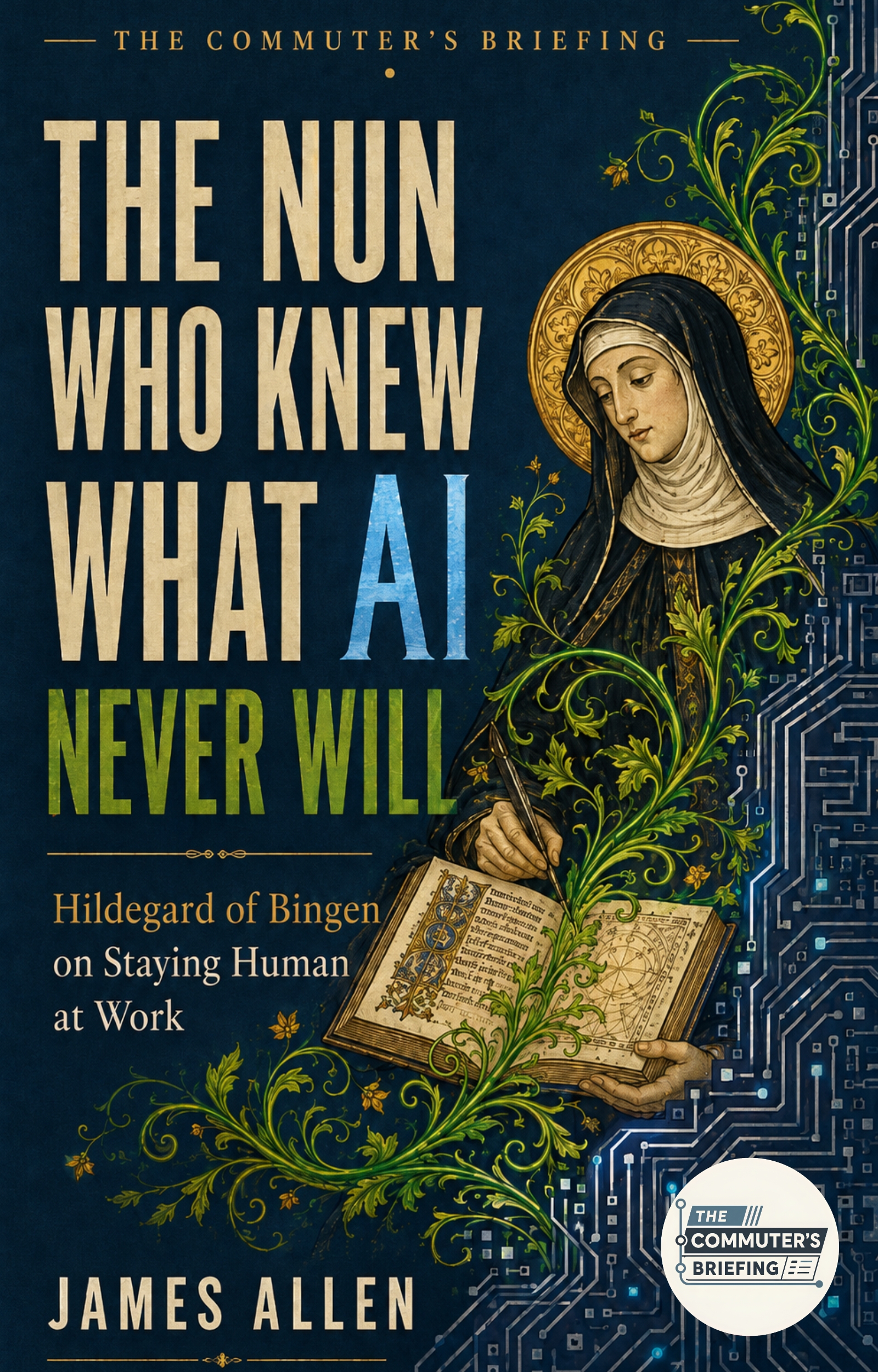
The answer, oddly enough, comes from a 12th-century nun who never saw a computer but understood something about work that we've forgotten.
Hildegard of Bingen
Her name was Hildegard of Bingen.
She was born in 1098 in the Rhineland, the tenth child of a noble family, and given to the Church as a tithe—a medieval practice that sounds barbaric until you realize it was often the only way a clever girl could get an education. She spent her childhood in a cloister attached to a Benedictine monastery, learning to read Latin, studying scripture, and experiencing visions she didn't yet have the authority to share.
She didn't write anything down until she was 42.
When she finally did, she became one of the most extraordinary figures of the Middle Ages. She founded her own abbey. She composed music that's still performed today—70 surviving pieces, which makes her one of the largest known contributors to medieval sacred music. She wrote theology, natural history, medical texts. She corresponded with popes, emperors, and kings, often to tell them they were wrong. She preached publicly, which was essentially illegal for a woman. She got away with it because people recognized that she had something they didn't: not just knowledge, but aliveness.
The word she used for it was viriditas.
It's usually translated as "greenness," but that makes it sound like an aesthetic preference for plants. It wasn't. Viriditas was Hildegard's word for the fresh, fertile, vital force present in living creation. It was what separated a thriving garden from a dead one, a healthy body from a sick one, genuine creativity from mere repetition. It was the quality that made something alive rather than just correct.
And it's the thing your work is losing.
The Green Advantage
Here's the central argument of this book:
AI can make work correct, polished, and fast. Human beings make it alive, meaningful, and worth doing.
As machines get better at producing competent output, the most valuable people will be those who can bring work to life. Not because they've learned fancier prompts. Not because they've become "AI-native." But because they've remembered how to do the distinctly human work that no amount of processing power can replicate.
That work has five dimensions, and Hildegard understood all of them:
Voice. The courage to say what you actually think before asking the machine what it thinks.
Aliveness. The ability to recognize when work is technically correct but spiritually dead—and to choose life.
Discernment. The embodied knowledge that comes from experience, relationship, and paying attention to what the dashboard misses.
Integration. The capacity to connect things that don't obviously belong together, to hear the music instead of just identifying the notes.
Conscience. The willingness to accept moral responsibility for decisions, even when a system has recommended them.
These aren't soft skills. They're not the things you do after the real work is finished. They are the real work. They're what makes the difference between a business that thrives and one that dies efficiently. Between a leader people trust and one they tolerate. Between a career built on irreplaceable value and one built on tasks a subscription service can handle.
Two People
This book follows two people.
The first is Hildegard herself. Each chapter opens with a moment from her life—not as historical curiosity, but as a mirror for the dilemmas you're facing now. Her hesitation before writing. Her insistence on speaking truth to power. Her refusal to stay inside a single professional category. These aren't just interesting stories. They're templates for what it looks like to remain human under pressure to conform.
The second person is Rachel Chen.
Rachel is 43. She's Head of Customer Experience at a mid-sized B2B company. She's spent 18 years climbing from customer service associate to departmental leadership. She's good at her job. She remembers people's names. She reads management books. She genuinely believes that efficiency and human happiness can coexist.
And then her company announces an "AI-first transformation."
Over the course of this book, Rachel will face every anxiety you're facing. She'll wonder if she's about to become obsolete. She'll try to sound confident about things she doesn't believe. She'll watch her team stop thinking for themselves. She'll see metrics improve while something vital disappears. And she'll have to decide: Does she try to become more like the machine, or does she remember how to be human?
The Real Problem
Because here's the thing nobody's saying clearly enough: AI isn't the problem. Lifelessness is.
The technology is neutral. It's a tool. The danger isn't that it's too powerful. The danger is that it makes it easy—effortless, actually—to produce work that's correct, polished, efficient, and completely dead. Work that nobody cares about. Work that creates no energy. Work that could vanish tomorrow and nobody would miss it.
You've seen this work. You've probably produced it. It's the presentation that says all the right things and inspires nobody. The email that's perfectly professional and utterly forgettable. The strategy document that contains every buzzword and no actual thought. The performance review that applies to everyone and recognizes no one.
It's work without viriditas. Work without greenness.
And the more we automate, the more of it we create—unless we consciously choose otherwise.
The Promise
By the end of this book, you'll know how to recognize lifeless work. You'll know what makes work come alive. You'll know which parts of your job to automate and which parts to reclaim. You'll know how to stop hiding behind generated language and start offering genuine judgment. You'll know how to trust what the dashboard can't measure. You'll know how to connect things that don't obviously belong together. And you'll know how to accept responsibility for decisions instead of outsourcing them to systems.
You'll know, in other words, how to do the work that becomes more valuable precisely because machines can't do it.
This isn't about becoming a Luddite. It's about using the tools without letting them use you. It's about remembering that efficiency is a means, not an end. It's about recognizing that the point of work isn't just to produce output—it's to create something worth producing.
Hildegard knew this 900 years ago. She called it greenness.
We're going to call it the Green Advantage.
And we're going to start with the thing that's hardest: finding your voice when you're not sure what you think anymore.