Spider-Man, the Roman Empire and why the wrong person sometimes gets the credit at work.
There are currently two perfectly reasonable reactions to somebody saying:
"I really like Tom Holland."
The first is:
"Absolutely. Spider-Man was brilliant."
The second is:
"Absolutely. Rubicon completely changed how I think about the late Roman Republic."
These people should probably meet.
If you are under a certain age, Tom Holland is the British actor currently enjoying the sort of year that makes other actors reconsider their representation.
If you are over 42, listen to The Rest Is History, own an unnecessarily detailed map of the Roman Empire or have ever used the phrase "Julio-Claudian" recreationally, Tom Holland may still mean the historian.
One swings between buildings.
The other can explain why the buildings eventually belonged to the Visigoths.
Both are British.
Both are extremely successful.
And Google has chosen sides.
The Spider-Man Problem
There is, appropriately enough, a Spider-Man meme for this.
The famous image comes from the 1967 cartoon episode Double Identity: two identically dressed Spider-Men stand pointing accusingly at one another.
It subsequently became one of the internet's preferred ways of saying:
Wait. You're me.
Tom Holland the actor, Tobey Maguire and Andrew Garfield even recreated it together in 2022.
Now imagine the same scene.
On the left:
Tom Holland, historian, broadcaster, author of Rubicon, Persian Fire, Pax and Dominion.
On the right:
Tom Holland, Spider-Man, husband of Zendaya, possessor of considerably more Lycra.
Point.
Point.
Somewhere behind them, an exhausted search engine gives up.
This isn't entirely hypothetical. The historian has previously found himself receiving social-media attention intended for the actor.
But this is where the joke becomes useful.
Because workplaces have Tom Holland problems all the time.
The Big Idea
Human beings are not particularly good at distributing credit.
We like neat stories.
A project succeeds, therefore somebody must have made it succeed.
A good idea appears in the meeting, therefore we remember the person who said it most memorably.
A presentation lands brilliantly, therefore we praise the person standing beside the screen.
Meanwhile, three desks away, somebody who built the spreadsheet, found the mistake and rewrote slide 17 is eating a Boots meal deal in complete anonymity.
Recognition attaches itself to recognisable people.
Sociologist Robert K. Merton identified a version of this in science and called it the Matthew effect: already prominent scientists can receive disproportionate credit for work, while less-established researchers doing comparable work attract less recognition.
Fame attracts credit.
Credit creates fame.
Soon everybody remembers the Spider-Man.
The Roman historian starts receiving questions about Zendaya.
And Then There Is Tom Hollander
At which point we must introduce a third man.
Tom Hollander.
Not Tom Holland.
Tom Hollander.
Excellent actor. The White Lotus, Pride & Prejudice, The Night Manager.
And owner of perhaps the finest administrative-error story in modern celebrity history.
Hollander has recounted being represented briefly by the same agency as the younger Tom Holland. One day an email arrived containing details of a box-office bonus.
For a glorious moment, Hollander apparently saw a sum of money so enormous that it caused him to reassess his understanding of economics.
Unfortunately, it belonged to Spider-Man.
The agency had sent it to the wrong Tom.
This may be the purest possible expression of workplace credit confusion.
You have the same first name.
Almost the same surname.
You open the email.
You are momentarily richer beyond imagination.
Then somebody notices the final two letters.
There are performance reviews that have felt similar.
"Actually, That Was Sarah's Idea"
The everyday workplace version is less spectacular but more important.
Someone suggests something in a meeting.
It is ignored.
Ten minutes later somebody else expresses essentially the same idea with greater confidence.
Suddenly:
"That's really interesting, Mark."
Sarah looks across the table.
Sarah knows.
Mark may not even have done anything deliberately.
Attention is messy.
We remember confident delivery.
We associate authority with seniority.
We remember the person whose name we already knew.
Credit isn't stolen so much as misdirected.
Like Tom Hollander's email.
Which means one of the simplest acts of good leadership is also one of the least glamorous:
correct the attribution.
"That's building on Sarah's point from earlier."
"James did the analysis behind this."
"The team in Manchester actually found that problem."
"I'm presenting this, but Priya did most of the work."
Fourteen words can sometimes do more for workplace culture than an annual values workshop involving coloured Post-it notes.
Names Become Shortcuts
The difficulty is that organisations need shortcuts.
You cannot maintain a complete intellectual audit trail for every good idea.
Nobody wants meetings to start resembling the acknowledgements section of an academic monograph.
But shortcuts have consequences.
The visible person becomes associated with the work.
The person associated with the work becomes more visible.
And eventually the organisation begins sending all the Spider-Man correspondence to the historian.
This is partly why good managers narrate contribution.
They don't simply say:
"Great result."
They say:
"Rachel spotted the problem, Mohammed rebuilt the model and Ellie got the client over the line."
Specific credit teaches an organisation where its competence actually lives.
That matters when promotion time arrives.
The Other Tom Holland
There is also something rather cheering about the fact that the historian Tom Holland has not responded to losing the world's most searchable version of his own name by changing career.
He remains an award-winning historian and broadcaster, co-presenting The Rest Is History and writing deeply readable histories of Rome, Persia, Christianity and the medieval world. His official biography lists a formidable catalogue including Rubicon, Persian Fire, Millennium, Dynasty, Dominion and Pax.
This may itself be useful.
Recognition is not identical to value.
Sometimes the person Google puts second has written the book you actually needed.
Before Your Stop
Think about something successful your team has done recently.
Now name the three people who actually made it happen.
Not the person who presented it.
Not necessarily the most senior person involved.
Who:
noticed something,
fixed something,
persuaded somebody,
or quietly did the difficult bit?
If you cannot answer, that may be worth noticing.
If you can, perhaps tell them.
📚 Today's Briefing Shelf
- A ClassicThe Comedy of Errors — William ShakespeareTwo sets of identical twins, repeated mistaken identity and mounting administrative chaos. Essentially Microsoft Teams with swords.
- A Rather Good DetourRubicon — Tom HollandThe historian one. A vivid, witty account of the final decades of the Roman Republic and still one of the best places to discover why quite a lot of people heard "Tom Holland" before 2016 and pictured a man explaining Cicero. If Rome is your thing, continue with Pax. If Persians and Greeks are more your commute, try Persian Fire. And for the enormous argument about how Christianity shaped Western assumptions, there is Dominion.
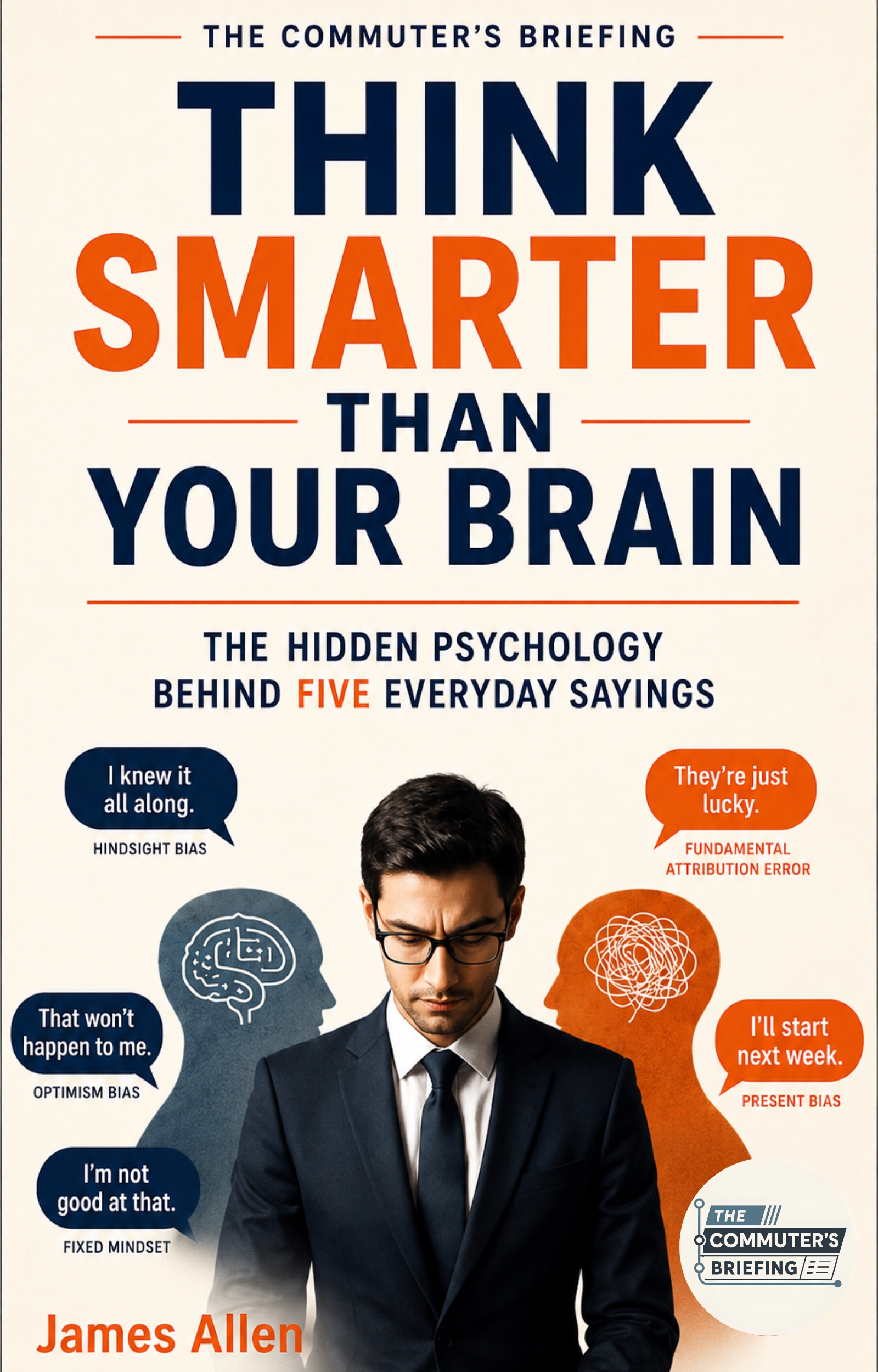
- From the ImprintThree Dead People Who Understand Your Workplace — James AllenWhat Elizabeth I, a Medieval Monk and an English Cowherd Knew About Conflict, Comparison and Confidence. Because the peculiar business of who gets noticed, who gets compared and who receives the credit is considerably older than LinkedIn.
💬 Conversation Starter
Who gets more credit at work: the person with the best idea, or the person who becomes associated with it?
James Allen · Tom Holland vs Tom Holland
Being the person associated with the work is not always the same as being the person who did the work.
So tomorrow, if somebody praises you for an idea that actually came from somebody else, correct the record.
It takes five seconds.
It costs nothing.
And it may prevent your workplace from becoming the human equivalent of the Spider-Man pointing meme.
As for Tom Holland and Tom Holland, both appear to be doing perfectly well.
Tom Hollander probably checks the recipient field on emails much more carefully now.