Smart Short Reads for Your Daily Commute
The Commuter's Briefing — One Idea. One Commute. Turn an ordinary journey into useful thinking time with short, entertaining briefings on psychology, history, philosophy, books, work and big ideas.
Short Kindle books and a free reading journal by James Allen. Each book carries a single idea, broken down into bite-sized chunks, and lasts about the length of a commute — no jargon, no padding, no four-hundred-page commitment. Short Kindle ebooks, each £4.99 — less than the price of a fancy coffee.
Big ideas for short journeys. The Commuter's Briefing offers intelligent short reads for busy people who remain curious about the world. Discover the psychology behind familiar behaviour, overlooked lessons from history, accessible introductions to important books and ideas that may prove unexpectedly useful at work. No jargon. No academic showing-off. No 400-page commitment. Just one memorable idea for the journey ahead.
Explore the Journal
·
Browse the books
·
About James Allen
·
The Commuter Concierge
Books by James Allen — Short Kindle Ebooks
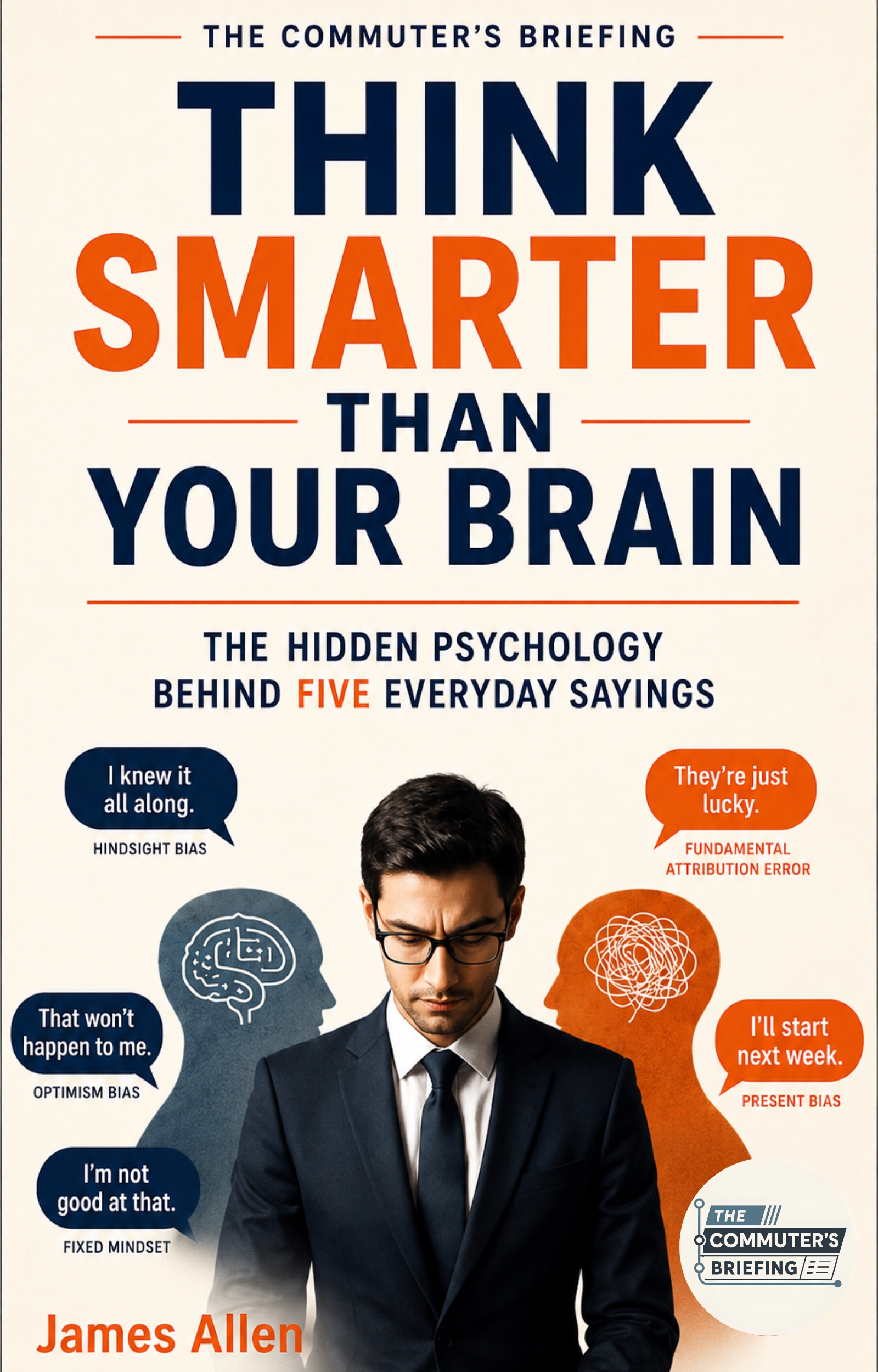
Think Smarter Than Your Brain
— The Hidden Psychology Behind Five Everyday Sayings. Behavioural science. Give them the benefit of the doubt. Birds of a feather. Meet someone halfway. We hear these phrases so often they fade into the wallpaper — yet each one carries a piece of psychology worth pausing over. Kindle ebook, £4.99.
The Monk Who Invented Deep Work
— What a Sixth-Century Monk Knew About Attention. History. Long before notifications, back-to-back meetings and the inbox that never empties, an Italian monk called Benedict wrote a rule for living that reshaped monasteries — and, in time, Western civilisation. Kindle ebook, £4.99.
AI and the Texas Sharpshooter Fallacy
— Why New Knowledge Needs Old Wisdom. Decision making. Artificial intelligence can find patterns in extraordinary numbers. Whether it can tell insight from coincidence is a different question. Kindle ebook, £4.99.
Japanese Stories Smarter Than Small Talk
— Five Ancient Lessons for Better Conversations at Work. Communication. The best stories do not tell you what to think. They teach you how to. Kindle ebook, £4.99.
Still Right
— Time-tested Proverbs to Equip Time-pressed Professionals. Wisdom. What if your grandmother gave sounder career advice than most business gurus? Kindle ebook, £4.99.
The Saint Who Solved Burnout
— What St Bonaventure Can Teach Us About Compassion, Simplicity and Thriving at Work. Philosophy. Eight hundred years ago a medieval friar was thinking about the same difficulties we grapple with now: burnout, perfectionism, the pressure to succeed. Kindle ebook, £4.99.
Britain Is Better Than Twitter
— How to Talk, Disagree and Get Along in a Divided Age. Communication. Twitter says Britain is furious, divided and falling apart. Your morning commute suggests otherwise. A funny, thoughtful and quietly hopeful exploration of why real life is usually kinder than social media makes it appear. Kindle ebook, £4.99.
The Nun Who Knew What AI Never Will
— Hildegard of Bingen on Staying Human at Work. Future of work. Artificial intelligence can write the email, summarise the meeting and recommend the next decision. But can it tell what matters? Nine hundred years ago, Hildegard of Bingen developed the idea of viriditas — the living greenness that separates growth from mere production. Kindle ebook, £4.99.
AI Knows the Notes. You Hear the Music.
— Ten Tests of Taste, Timing and Meaning in the Age of AI. Decision making. Artificial intelligence can now generate hundreds of polished answers in seconds. The scarce skill is no longer fluency. It is judgement. Across ten entertaining blind tests, a witty, practical guide to the human abilities that become more valuable as machines become more capable. Kindle ebook, £4.99.
Three Dead People Who Understand Your Workplace
— What Elizabeth I, a Medieval Monk and an English Cowherd Knew About Conflict, Comparison and Confidence. Workplace. Three people have followed you to work: the colleague who turns decisions into crises, the acquaintance dazzling on LinkedIn, and the voice in your own head. Three unexpected historical guides — Elizabeth I, Bernard of Cluny and Cædmon — offer three practical moves for the three great pressures of professional life. Kindle ebook, £4.99.
Why You Fancy Your Colleague
— Desire, Status and the Search for a Deeper Self. Psychology. You haven't done anything. You just appear to be thinking rather a lot about someone who once forwarded you a spreadsheet. Desire is information, not instruction. A funny, candid, humane and unexpectedly profound exploration of desire, status, attraction, marriage and the human need to be seen. Kindle ebook, £4.99.
How to Remain Calm and Useful
— When the Journey Is Beyond Your Control. Ancient Wisdom. Fifty timeless voices to galvanise your heart, mind, soul and strength. From Ptahhotep and Confucius to Seneca, Rumi, Julian of Norwich, Shakespeare and Mary Wollstonecraft — remarkably practical ideas for staying calm, thinking clearly and remaining useful when life refuses to follow the timetable. Kindle ebook, £4.99.
Articles from the Journal
The Digital High Street
— My most visited websites, and the village life we thought we had left behind. We didn't stop needing the village. We simply rebuilt much of it behind a screen. 21 August 2026, 9-minute read.
What 10FOOT Knows About Being Seen
— The graffiti writer who turned six characters into part of London. A lesson in how reputation compounds through repetition. 19 August 2026, 7-minute read.
Say Less, Mean More: The Claudia Winkleman School of Office Communication
— The best communicators in British television share a habit the best communicators at work would do well to copy. 4 August 2026, 6-minute read.
What AI Thought a Coffee Table Looked Like
— In the spring of 2025, while other people were using AI to improve productivity, I asked it to make coffee tables. The experiment became a book — and a record of the moment we stopped being astonished and started asking better questions. 4 August 2026, 12-minute read.
Idris Everywhere: Three Things Britain's Most Ubiquitous Man Gets Right
— Why Idris Elba's career holds lessons for anyone trying to build a working life that lasts. 2 August 2026, 5-minute read.
What Britain Googled in July
— A look at the nation's search habits and what they reveal about our collective curiosity. 1 August 2026, 5-minute read.
Finding Similarities in an Age of Division
— In a culture that rewards noticing differences, the quieter skill is noticing what we share. 30 July 2026, 5-minute read.
The Bourne Odyssey
— What Homer and Robert Ludlum have in common, and what both tell us about the journey to work. 28 July 2026, 5-minute read.
Why Your Office Is Basically Ancient Athens With Wifi
— The open-plan office has an older pedigree than anyone in facilities management would like to admit. 26 July 2026, 5-minute read.
Three Summer Reads Worth Missing Your Stop For
— Summer reading lists can become strangely intimidating. You begin by looking for something agreeable to read beside a pool. Twenty minutes later, you have been informed that the season's essential books include a 700-page family saga. 24 July 2026, 5-minute read.
Naming the problem
— Our readers have a curious habit. They quote us in meetings — then neglect to say where they found the line. We have decided this is the highest compliment we will ever receive. 20 July 2026, 4-minute read.
Why the short book will outlast the long one
— The modern book grew fat for commercial reasons. Here, brevity isn't a compromise — it's the standard. 12 July 2026, 6-minute read.
The commute as a reading room
— The train carriage is the last library that cannot be optimised away. It is dead time only if you let it be. 28 June 2026, 5-minute read.
On collecting ideas rather than books
— A shelf of briefings is a record of the ideas a reader has actually finished. Collecting is not hoarding. 14 June 2026, 6-minute read.
What They Should Read on the Train
Before I See The Odyssey
— Going to see Christopher Nolan's The Odyssey prompts a confession: I have never properly read Homer. So before the lights go down, here are three books about journeys worth taking — Homer's Odyssey in Emily Wilson's translation, Amor Towles's The Lincoln Highway and David Grann's The Wager. 24 July 2026, 3-minute read.
What Andy Burnham Should Read on the Train
— A recommendation of James C. Scott's Seeing Like a State. Governments love neat diagrams. Human beings insist on being gloriously untidy. 19 July 2026, 4-minute read.
What Keir Starmer Should Read on the Train
— A recommendation of Isaiah Berlin's The Hedgehog and the Fox. Are you the sort of person who explains the world through one enormous idea, or someone who collects lots of smaller truths? 12 July 2026, 4-minute read.
What Sadiq Khan Should Read on the Train
— A recommendation of Jane Jacobs' The Death and Life of Great American Cities. Cities don't become remarkable because someone drew a clever map. They become remarkable because millions of ordinary people quietly create them every day. 5 July 2026, 4-minute read.
What Angela Rayner Should Read on the Train
— A recommendation of Richard Sennett's Respect: The Formation of Character in an Age of Inequality. What does respect actually look like? Not admiration. Not agreement. Respect. 28 June 2026, 5-minute read.
What Kemi Badenoch Should Read on the Train
— A recommendation of John Stuart Mill's On Liberty. If nobody challenges your ideas, you never discover whether they're actually true or merely familiar. 21 June 2026, 4-minute read.
What Rory Stewart Should Read on the Train
— A recommendation of Albert O. Hirschman's The Rhetoric of Reaction. Three wonderfully persistent political arguments that have survived almost every generation. 14 June 2026, 4-minute read.
What Mary Beard Should Read on Holiday
— A recommendation of Italo Calvino's Invisible Cities. Disguised as conversations between Marco Polo and Kublai Khan, Calvino invents city after city — places built from memory, desire, fear, ambition and imagination. 18 July 2026, 4-minute read.
What Richard Osman Should Read Before Writing His Next Bestseller
— A recommendation of John le Carré's The Spy Who Came in from the Cold. People are rarely what they first appear to be. The most interesting character in the room is seldom the loudest one. 11 July 2026, 4-minute read.
What David Attenborough Should Read if He Ever Had a Day Off
— A recommendation of Robin Wall Kimmerer's Braiding Sweetgrass. Science asks how things work. Story asks why they matter. The best understanding usually requires both. 4 July 2026, 4-minute read.
What Taylor Swift Should Read on Tour
— A recommendation of Alain de Botton's The Consolations of Philosophy. Swift has built an extraordinary career by doing something philosophers have admired for centuries: turning personal experience into something universal. 27 June 2026, 4-minute read.
What Bruce Springsteen Should Read on the Bus
— A recommendation of Studs Terkel's Working. One of the finest books ever written about people describing what they actually do all day. 20 June 2026, 4-minute read.
What Dua Lipa Should Read Between Flights
— A recommendation of Rebecca Solnit's A Field Guide to Getting Lost. She argues that getting lost isn't always a mistake. Sometimes it's the only way we discover somewhere worth finding. 13 June 2026, 4-minute read.
What Stormzy Should Read Backstage
— A recommendation of James Baldwin's The Fire Next Time. Baldwin could write about race, identity, faith and justice with extraordinary honesty while never forgetting the humanity of the people reading his words. 6 June 2026, 4-minute read.
What Brian Cox Should Read Between Galaxies
— A recommendation of Carl Sagan's Contact. Sagan wasn't really writing about astronomy. He was writing about thinking. 30 May 2026, 4-minute read.
The Monday Briefing
What Gets to Change You?
— Andy Burnham, the Great North Run, and the quiet business of staying yourself. You cannot stop the world changing you. But you can have some say in what it changes you into. 14 September 2026, 8-minute read.
What Murdle Knows About Monday Morning
— The week ahead may look rather different once you find the puzzle hiding inside it. A problem tells you something is wrong. A puzzle asks what you have not spotted yet. 7 September 2026, 7-minute read.
The People Who Turn Up
— Why the worst moments can reveal a larger world than fear allows us to see. Tragedy narrows the world to what has been lost. Kindness quietly widens it again. 31 August 2026, 8-minute read.
Apparently We Can Now Forecast the Weather a Year Before It Happens
— What the Met Office's El Niño warning can teach us about probability, preparation — and what Erasmus knew about acting before certainty arrives. The most useful warnings arrive before they can tell you exactly what is going to happen. 24 August 2026, 8-minute read.
When the Government Makes Your Phone Scream
— Wildfires, air-raid sirens and why Epictetus might be more useful than Orwell. An alarm is useful only if it turns fear into sensible action. 17 August 2026, 7-minute read.
Why Standing at the Bar Matters More Than You Think
— What \u201cvertical drinking\u201d can teach us about pubs, strangers and the disappearance of accidental conversation. A table lets you talk to your friends. A bar lets you acquire some. 10 August 2026, 8-minute read.
The Complaint Journal
— Every day seems to arrive carrying a fresh invitation to be annoyed. A complaint journal isn't really about complaining — it's about catching yourself in the act. 3 August 2026, 6-minute read.
What the Commonwealth Games Quietly Remind Us About Success
— There is something wonderfully unfashionable about the Commonwealth Games. Modern life encourages us to think in Olympic terms, but most worthwhile achievements aren't Olympic — they're Commonwealth. 27 July 2026, 5-minute read.
What Spain's World Cup Victory Can Teach a New Prime Minister
— Britain has a new Prime Minister. Spain has a new World Cup trophy. Great victories look sudden only because we did not watch the years of patient work that made them possible. 20 July 2026, 6-minute read.
When Europe Suddenly Became a Weekend Away
— There was a time when flying abroad carried roughly the same emotional weight as a moon landing. The greatest gift of affordable travel wasn't cheaper holidays. It was making curiosity available to millions. 6 July 2026, 5-minute read.
Everyone Wants Certainty. History Has Other Plans.
— The trouble with modern life is that we're all expected to have opinions before breakfast. The wisest people are often distinguished not by having the quickest answers, but by asking the best questions. 13 July 2026, 5-minute read.
The Office That Banned the Reply-All
— A London consultancy has removed the reply-all button from Outlook. The results were immediate, and deeply instructive. Most reply-alls are written for the sender, not the receiver. 14 July 2026, 4-minute read.
When the Chess Robot Lost Its Temper
— A chess-playing AI resigned mid-game against a teenager in Berlin. The engineers say it was a bug. The rest of us are not so sure. Giving up requires a sense of futility, and futility requires a self. 7 July 2026, 4-minute read.
The CEO Who Reads Fiction on Purpose
— A FTSE 100 chief executive told a conference she reads a novel a week. The audience of analysts did not know what to do with the information. A novel is a management skill wearing different clothes. 30 June 2026, 4-minute read.
The Meeting That Wasn't
— A tech company cancelled all recurring meetings for a week. Productivity rose. So did complaints. A meeting with eight people costs eight hours, not one. 23 June 2026, 4-minute read.
Topics
The Commuter Concierge
The Commuter Concierge is your personal librarian inside The Commuter's Briefing. Tell her how long your journey is, what kind of day lies ahead and what you would like to take from it, and she will select an article, book or reading recommendation from the Library — a smart short read, a memorable idea and a conversation starter chosen for your journey. No account required.
Ask The Librarian
— answer three short questions and receive a personal recommendation from the Library.
More Pages